
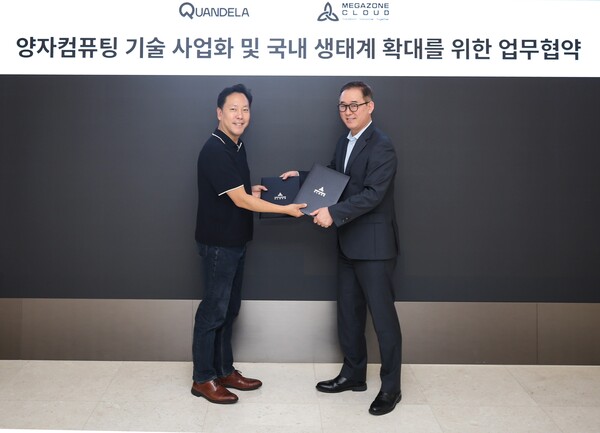
AI and cloud company MegazoneCloud said on Sept. 3 it will work with photonic quantum computing company Quandela to develop South Korea's photonic quantum computing market.
Photonic quantum computing uses photons, particles of light, as information processing units. A photonic-based quantum processor (QPU) performs calculations with these photons. It is seen as easier to combine with existing optical communications technologies such as optical fibre because it uses light, and it is assessed as having a relatively lower burden of cooling entire equipment to extremely low temperatures than superconducting methods.
The companies agreed to create a foundation that allows domestic customers to use and verify quantum computing in real-world environments.
The companies will build a hybrid computing environment in the cloud linking GPUs and photonic-based QPUs and jointly conduct technology validation. They will support domestic companies, universities and research institutes so they can verify quantum computing without separate large-scale infrastructure investment. The companies will also develop industry-specific use models and cases and pursue market expansion efforts including participation in government research and development projects and demonstration projects, and building on-premises photonic quantum computers.
MegazoneCloud stressed that it has expanded a foundation spanning different quantum hardware approaches by working with photonic-based Quandela after signing an agreement in July with neutral-atom quantum computing company Pasqal.
As part of the cooperation, Quandela participated as a sponsor in the quantum computing hackathon "Quantum Reframing Challenge 2026" that MegazoneCloud and the Korea Institute of Science and Technology Information (KISTI) co-hosted on Aug. 26.
MegazoneCloud CQO Dong-ho Kim (김동호) said, "As the complexity of AI and data analytics computation grows, there is a need for next-generation technology to complement existing computing, but opportunities to access and verify actual QPUs in Korea are limited." He added, "Through this agreement, we will enable customers to verify practical usability in connection with GPU, cloud and AI environments, and expand Korea's foundation for using quantum computing and its pool of specialised talent."
 Chi-gyu Hwang (황치규)
delight@d-today.co.kr
Chi-gyu Hwang (황치규)
delight@d-today.co.kr