
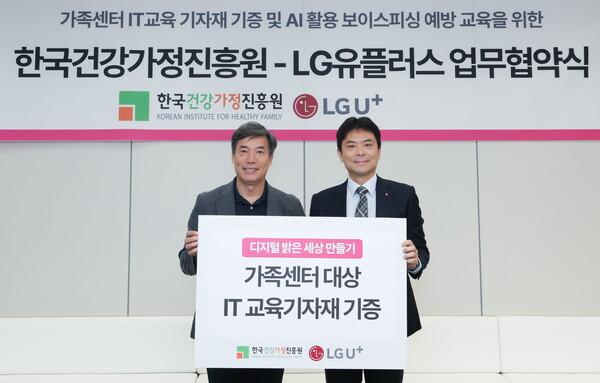
LG Uplus will work with the Korea Institute for Healthy Family to strengthen digital capabilities for digitally vulnerable groups, including multicultural families and single-person households.
LG Uplus said on Wednesday it signed a memorandum of understanding with the institute to strengthen digital capabilities for multicultural families and single-person households. The institute, a public agency under the Ministry of Gender Equality and Family, supports and manages 244 family centres nationwide.
The agreement was set up to expand LG Uplus' digital education project, which it ran at some family centres this year, to a nationwide level. Based on the deal, the two organisations will run smartphone and AI training, voice phishing and smishing prevention education, and digital skills programmes.
LG Uplus will provide IT training equipment, including smart TVs and laptops and tablets. The equipment will be used for digital education programmes at family centres and to build training infrastructure. The two organisations will also cooperate on joint promotion to spread a culture of digital inclusion and to identify best practices.
Earlier, LG Uplus ran training at family centres in Ansan, Gwangmyeong and Hwaseong for multicultural families and marriage immigrants, including smartphone use, hands-on generative AI practice and voice phishing prevention education. A total of 103 people took part, and the average satisfaction score was 4.6 out of 5.
LG Uplus and the institute will expand the programme to family centres nationwide based on the pilot results. The goal is to build a community-based digital capability strengthening model.
Park Gu-yeon (박구연), head of the Korea Institute for Healthy Family, said, "We will continue to cooperate with LG Uplus so that diverse families can adapt smoothly to the digital society and build their capabilities."
Joo Yong-han (주용한), head of consumer HR at LG Uplus, said, "Together with the Korea Institute for Healthy Family, we will raise access to information for digitally vulnerable groups such as multicultural families and single-person households and support everyone to enjoy the benefits of digital technology."
 Jin-ho Lee
jhlee26@d-today.co.kr
Jin-ho Lee
jhlee26@d-today.co.kr