
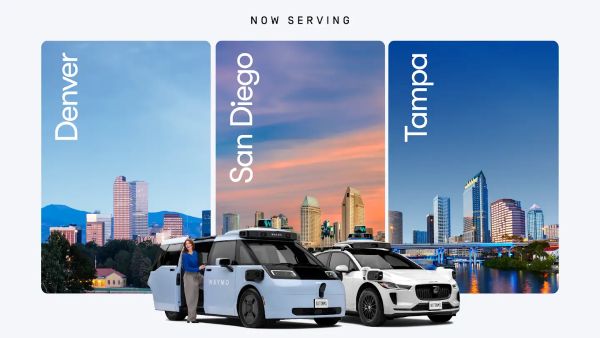
Waymo has started robotaxi service for general passengers in three U.S. cities, including Tampa, San Diego and Denver. The expansion brings the number of cities with Waymo's publicly available fully autonomous driving service to 14.
On Sept. 1, local time, Waymo began operating robotaxis for general passengers in Denver, San Diego and Tampa, multiple foreign media outlets including electric vehicle publication CleanTechnica reported. Waymo plans to expand users in stages as it pushes toward a full public rollout. The company said tens of thousands of people in each city have already registered and expressed interest in riding.
Still, the start of service does not mean robotaxis can be hailed immediately across each entire city. Waymo vehicles currently pick up and drop off passengers only in designated areas in each city. Waymo's position is that it will build service coverage first in areas with high real-world travel demand and clear user usefulness, then expand gradually.
Waymo said it designed service areas around places people actually need or want to travel to. It said the service can be used for everyday errands, getting home after late-night work, and situations where a safe means of transport is needed. It plans to widen operating areas in each city and connect to more destinations.
Waymo said the three-city expansion is an extension of its 2026 push to grow its robotaxi business. The company fully opened access to users in Dallas in August and is increasing users in new cities in stages as well. Waymo's commercial robotaxi service has expanded to 14 cities in the United States with the latest rollout.
Susan Philion (수잔 필리온), Waymo's chief marketing officer, said the company is focused on making everyday travel across the United States safer, more convenient and easier to access. She said starting public rides in San Diego and Tampa and in Colorado, her hometown, means providing more users with its latest vehicle platform and next-generation autonomous driving system.
Local groups and users also expressed expectations about the expansion. Laura Streed (로라 스트리드), director of outreach and engagement at the Florida chapter of AARP, said it is important to be able to choose among various transportation options. She said Waymo could become a new means of mobility for older people who no longer want to drive.
In San Diego, reactions also came from visually impaired users. Julia Cardenas (줄리아 카르데나스), head of the San Diego chapter of the National Federation of the Blind, said that when using existing ride-hailing services, there were times she felt anxious because she could not know whether a driver would refuse to allow a guide dog to ride. She said Waymo's service provides freedom and convenience in that users can ride in a vehicle without a driver and travel with a guide dog.
Waymo's robotaxi expansion is not limited to increasing the number of service cities, and how quickly it widens service coverage in each city is emerging as a key task. With the current approach of accepting users in stages in limited areas, the pace of future service-area expansion and full opening to general users is expected to be a key indicator of business expansion.
 Seungah Yoo
ysah@d-today.co.kr
Seungah Yoo
ysah@d-today.co.kr