
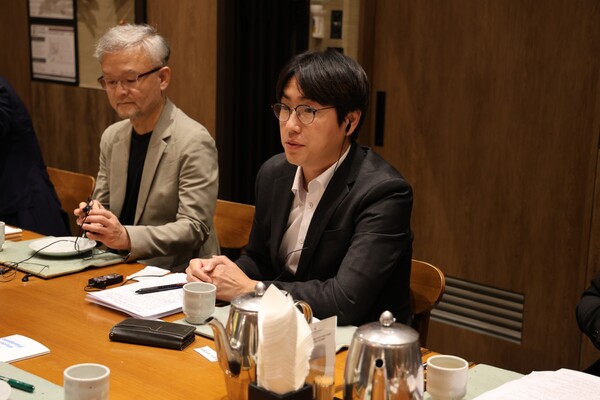
South Korea's National AI Strategy Committee discussed employment, social inequality and democratic accountability stemming from AI transition, or AX, with key European policy and labour figures.
The committee said on Sept. 1 it met a high-level European delegation from the Friedrich Ebert Foundation's (FES) 2026 Future of Work Lab and discussed AI policy and the direction of social dialogue between Korea and Europe under the theme of building a national AI strategy with social legitimacy.
Attendees included Nicolas Schmit, chairman of the Foundation for European Progressive Studies (FEPS), European Parliament member Brando Benifei, Esther Lynch, general secretary of the European Trade Union Confederation (ETUC), Gaby Bischoff, vice chair of the Socialists and Democrats (S&D) group in the European Parliament, and Annika Klose, a member of the German Bundestag, among 12 European policy and labour figures.
From the National AI Strategy Committee, attendees included full-time Vice Chair Ha Jung-woo (하정우), Park Tae-woong (박태웅), head of the Public AX Subcommittee, Kim Eui-young (김의영), head of the AI Democracy Subcommittee, Lee Dong-soo (이동수), a member of the Technology Innovation and Infrastructure Subcommittee, Kim Young-ok (김영옥), a member of the Industrial AX and Ecosystem Subcommittee, and Kim Kyung-hoon (김경훈), a member of the Social Subcommittee.
The two sides agreed that when drawing up a national AI strategy, governments should consider jobs, social inequality, social security, public trust and democratic accountability, as well as technological competitiveness and industrial growth. They also discussed the importance of social dialogue involving government, industry, labour and civil society during the AI transition process.
The committee explained that the government is pursuing an "AI Basic Society" in which all citizens enjoy the benefits of AI, along with its drive to become one of the world's top three AI powers. It also introduced that it is prioritising the use of AI for essential social services and its "AI for All" policy.
Ha said, "AI competitiveness is not completed by technological and industrial achievements alone, but can become sustainable national competitiveness when supported by public trust and participation." He added, "We need to create a new national model in which technology and democracy develop together in the AI era, beyond simply becoming a country that uses AI well."
 Seulgi Son
sageson@d-today.co.kr
Seulgi Son
sageson@d-today.co.kr