
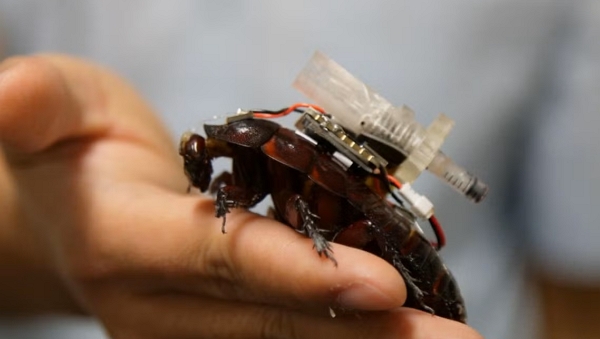
An Australian research team has developed a cyborg cockroach that can deliver first aid to survivors in environments that are hard for rescuers to access, such as collapsed buildings or caves. It is a biohybrid robot that combines the strong mobility of a live insect with a camera and a micro-injection device.
On Aug. 29 local time, IT outlet TechRadar reported that a joint research team from the University of Queensland (UQ) and the University of New South Wales (UNSW) developed Paraborg by fitting electrodes and lightweight electronics onto a large burrowing cockroach native to northern Australia. The findings were published in the international journal Advanced Science.
Paraborg relays its surroundings through a camera and is remotely controlled by a person to move to a target point. Other individuals were fitted with a remotely operated automatic injection device so they can deliver liquid medication. The researchers said they anesthetised the cockroaches when attaching the equipment and that the insects maintained a lifespan similar to normal individuals after the devices were removed.
In a proof-of-concept test, the system recorded a success rate of up to 95 percent when attempting injections within 15 cm of a target. The overall mission success rate was 72 percent for the full task of moving through multiple points to reach the target, stabilising posture and then performing the injection. The researchers tested the feasibility of the injection device using silicone targets rather than actual patients.
Hai Nhan Le (하이 난 레), a doctoral researcher at UQ, said the key challenge is stabilising the insect’s posture enough to allow an injection after it accurately approaches the target. The team is considering deploying multiple cyborg insects at the same time with different roles, such as individuals responsible for cameras and environmental sensors and others carrying medical equipment.
Fire authorities also took note of the potential. Tim Hassiotis (팀 하시오티스), a superintendent at Fire and Rescue NSW, said that if it can find victims and provide emergency support in spaces rescuers cannot enter, it could become a new tool for urban search and rescue.
Still, it remains a long way from deployment in real disaster sites. Verification in actual collapse environments where communications are unstable and terrain is complex, safety assurance and regulatory approval are needed. The team aims to use cyborg insects at real rescue sites within 5 to 10 years if adequate funding and field tests are in place.
 Choi Jae-won
ittt_0801@d-today.co.kr
Choi Jae-won
ittt_0801@d-today.co.kr