
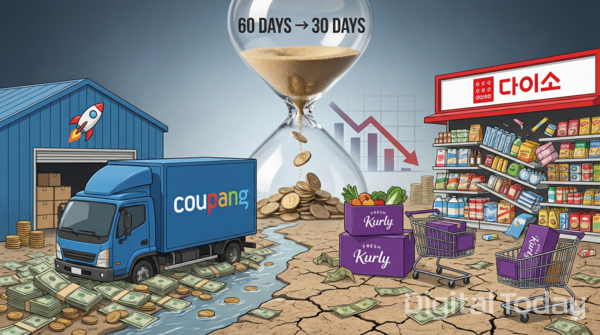
As the government pushes to revise the law to shorten settlement cycles in the retail industry, liquidity management has become a pressing issue not only for direct-purchase-based e-commerce firms such as Coupang and Kurly but also for offline powerhouses including Daiso.
The Fair Trade Commission said on Jan. 12 it plans to submit an amendment to the Act on Fair Transactions in Large Franchise and Retail Businesses within the first quarter. The amendment would shorten the payment deadline for direct purchases to 30 days from 60 days, and for special-contract purchases to 20 days from 40 days.
In a payment-practice survey previously conducted by the commission, 9 of 62 direct-purchase-based retailers were found to pay suppliers very close to the legal deadline. The commission named Coupang, with an average of 52.3 days, Kurly, with an average of 54.6 days, and Daiso, with an average of 59.1 days, as representative firms.
The scale of their accounts payable suggests the potential ripple effect. Coupang’s accounts payable stood at $6.795 billion, about 10 trillion won, according to its third-quarter 2025 report filed with the U.S. Securities and Exchange Commission. Accounts payable refers to payments made after goods are supplied first by vendors and a certain period has passed.
Coupang also reinvests more than half of its surplus profit in logistics. Its operating profit margin in the third quarter of 2025 was 1.7 percent. Cumulative cash flow from operating activities for the first to third quarters was $1.691 billion, about 2.46 trillion won, while cash outflows from investing activities over the same period totaled $878 million, about 1.27 trillion won.
In its third-quarter report, Coupang explained that cash flow from operating activities was affected by working capital changes stemming from inventory purchases and the timing of payments to partners, and that an increase in accounts payable in particular affected cash flow.
Kurly’s accounts payable stood at about 231.5 billion won as of the end of 2024. That is about 3 times its cash and cash equivalents of about 135.1 billion won. Kurly, which turned profitable in operating profit for the first time in the first quarter of 2025, could feel liquidity pressure more than Coupang.
Asung Daiso is also within the impact range. Daiso’s accounts payable totaled about 366.5 billion won on a consolidated basis in 2024. It generates annual operating profit of more than 370.0 billion won and has relatively strong capacity to mobilise cash, but a shortened payment deadline for accounts payable that had effectively been operated interest-free could increase its interest burden.
An industry official said direct-purchase operators carry liabilities from buying inventory rather than settling sales proceeds for sellers, making the consistency of the system somewhat questionable. The official said that if the payment deadline is brought forward, liquidity will decline and companies may adjust some purchase volumes or, in the short term, consider issuing commercial paper or corporate bonds.
Yeonseung Lee, a professor of business administration at Dankook University, said cash should be viewed as a resource used for investment or product development in the business models of platform companies. He said shortening settlement cycles would inevitably bring fundamental changes to the structure and pose a significant challenge to the direct-purchase model.
 Seulgi Son
sageson@d-today.co.kr
Seulgi Son
sageson@d-today.co.kr