
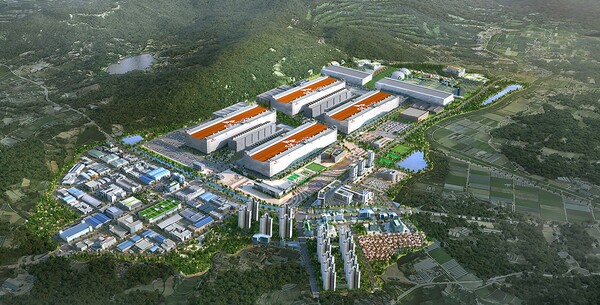
SK Hynix is stepping up the build-out of memory infrastructure. The first fab in Yongin is in the final stage of construction, and the investment size and groundbreaking timing for follow-on fabs have also been set.
Industry sources say SK Hynix will hold a groundbreaking ceremony on Aug. 27 in Indiana for a $3.9 billion advanced packaging plant. In South Korea, progress on Y1, the first fab at the Yongin semiconductor campus, has reached 87%. The company has also confirmed 54 trillion won to be投入 in two follow-on fabs. At the government-led Honam semiconductor cluster, a decision confirmed this month is to bring forward the power-grid construction schedule by 1 year.
SK Hynix held a board meeting on Aug. 7 and decided to invest 35.2 trillion won in Y2, the second fab in the Yongin semiconductor cluster, and 19.1 trillion won in Cheongju’s M17. It follows a mid- to long-term investment plan announced in June. Y2 is a DRAM production facility with a total floor area of 341,000 pyeong and will produce next-generation DRAM, including high bandwidth memory (HBM). Construction starts in July next year, the first cleanroom opens in June 2029, and investment continues through October 2031. Cheongju’s M17 is a NAND flash production facility with a total floor area of 206,000 pyeong, with construction set to start in February next year and the first cleanroom targeted to begin operations in December 2028.
The schedule has been brought forward by an even wider margin. The company previously decided to move the completion date for construction of four fabs at the Yongin cluster to 2033 from 2045, bringing it forward by 12 years. In the same period, what was confirmed for the Honam semiconductor cluster was the infrastructure schedule. Industry sources say the government on Aug. 11 shortened the power-grid construction schedule for the Honam semiconductor industrial complex by 1 year to end-2028 from end-2029. The timing for temporarily relocating the functions of the Gwangju military airbase, which will serve as the site, is set for mid-2028.
The basis for the shortened schedule lies in demand 전망. Market research firm Omdia projected DRAM and NAND demand to grow at an average annual rate of 19 percent each from last year through 2030. Mirae Asset Securities also estimated memory supply and demand would remain tight through 2028 and forecast that DRAM average selling prices would rise 188 percent and 23 percent in 2026 and 2027, respectively. It also said the share of long-term supply agreements (LTAs) has exceeded 50 percent, reducing earnings volatility.
In the longer term, there is also an assessment that China-driven supply disruption is possible, but still limited. According to Mirae Asset Securities, Chinese local companies see the timing for becoming self-sufficient in HBM3-class products as about 2 years away. It explained that the more China’s CXMT shifts capacity to HBM to cover shortages, the encroachment rate would be close to four times, which would instead reduce supply of general DRAM.
Memory shortage to continue through 2028... Semiconductor clusters spill over into construction demand
Confirmed investment is expected to translate into construction volume. According to iM Securities, the total floor area for construction of four fabs at SK Hynix’s Wonsam cluster in Yongin is estimated at about 6 million square metres. The contract value construction firms can expect is about 20 trillion won per fab, or 80 trillion won for all four.
The government has moved faster on procedures. The government plans to introduce a separate permit system for factory expansion at the Yongin semiconductor cluster to unlock 4.3 trillion won in investment waiting at sites. It is also pushing to speed up 2.5 trillion won in investment by improving the building permit system. For the 1 trillion won semiconductor water-supply project in the southwest, it is pursuing an exemption from the preliminary feasibility study.
Power constraints, however, remain a key issue. A plan for 1,100 km of extra-high-voltage transmission lines to supply electricity to the Yongin cluster has faced opposition from residents along the route. The government aims to enact by year-end a special act on mega-special zones to support three mega projects, but a key issue, an exemption from the 52-hour workweek system, remains undecided.
For SK Hynix, whether the first shovel goes into the ground at the Honam semiconductor cluster is expected to determine whether its timely supply timeline continues smoothly. Power supply to the Honam fab site is scheduled for end-2028, and the temporary relocation of Gwangju military airbase functions is set for mid-2028. An industry official said, "Specific construction plans have not been decided, but they are expected to progress once power and water plans are resolved."
 Dae-geon Seok
d2dg@d-today.co.kr
Dae-geon Seok
d2dg@d-today.co.kr