
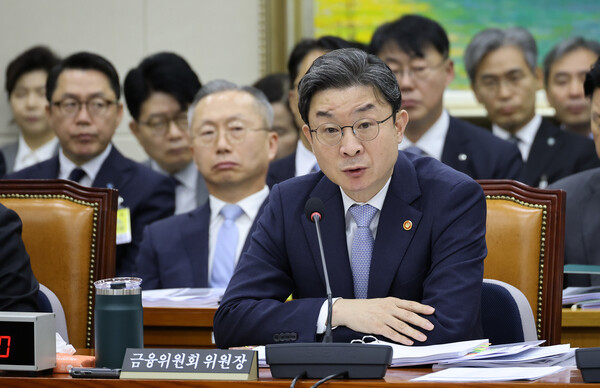
Financial Services Commission Chairman Lee Eok-won said the second stage of legislation for the Digital Assets Framework Act, including institutionalisation of stablecoins, is in its final phase. "We have already prepared the contents and are in final consultations," he said.
Lee made the remarks on Oct. 8 in Seoul during a National Assembly audit of the Financial Services Commission by the National Policy Committee, answering a question from Democratic Party lawmaker Lee Kang-il (이강일) on institutionalising digital assets.
Lee Kang-il said domestic preparations are being delayed as major countries including the United States and Europe speed up legal frameworks for digital assets.
"Countries around the world are competing to preempt digital asset standards, such as the U.S. GENIUS Act and the CLARITY Act and Europe’s MiCA, but we have not even put out a basic design," he said. "If this continues, won’t we be handing market leadership to other countries?"
He also pointed to delays in institutionalising a won-denominated stablecoin as domestic trading of overseas stablecoins, including dollar stablecoins, expands.
"Domestic trading volume of dollar stablecoins exceeded 6 trillion won in June alone, and cumulative trading volume through July reached 80 trillion won," he said. "Fifty-four percent of yen stablecoin trading volume is occurring in the Korean market."
He added that while there is still no conclusion on who would issue a won stablecoin, a company based in the Cayman Islands has issued a won stablecoin. He said moves have also emerged to link it with domestic companies for uses such as in-app payments and game settlement.
He also raised the need to improve the system for the token securities (STO) and real-world asset (RWA) markets.
He said tokenised stocks and government bonds, money market funds (MMF) and the on-chain RWA market are expanding globally. He said South Korea should also build an institutional foundation for related businesses such as tokenising listed stocks.
"While government policy has been delayed, 63 trillion won of funds flowed overseas through last month this year based on our own tally," he said. "If this continues, products, liquidity and market standards will all be taken overseas."
He asked about the financial authorities’ stance on the stablecoin issuance framework, license operation for five won digital asset exchanges, and concerns over expanded market dominance from a combination of Naver Financial and Dunamu, which operates Upbit.
He also demanded a policy direction on the expansion of payment and lending by large fintech firms, splitting digital asset exchange licenses, and the timing for allowing stock STOs and RWAs and digital asset derivatives.
Lee said work on the Digital Assets Framework Act and institutions related to stablecoins has progressed to a considerable extent.
"We have already prepared the contents and are in final consultations," he said. "We will quickly consult and organise the overall direction for how to lead the industry and the market."
On stablecoin types and the digital asset exchange licensing system, he set out a policy of operating the system in consideration of market conditions.
"Types and licenses are parts we will operate as policy while watching market conditions," he said. "We will firmly put in place various ways to move forward safely and solidly while not falling behind global trends."
Lee also bowed his head, saying he was sorry about investor losses and market confusion after the introduction of single-stock leveraged exchange-traded funds (ETFs).
Democratic Party lawmaker Kim Hyun-jung (김현정) pointed to high-frequency trading groups and market surveillance by the Korea Exchange as the core of the single-stock leveraged ETF issue.
HFT is a trading method that repeatedly places and cancels large orders in a short period using computer algorithms. Kim raised the possibility that some HFT traders used the rebalancing structure in which leveraged ETFs mechanically buy and sell underlying assets to hit target leverage ratios near the market close to gain arbitrage profits.
According to Kim, monthly average HFT trading value rose 52 percent to 4,200 trillion won in June to August after the listing, from 2,700 trillion won in January to May before the listing of single-stock leveraged products. HFT trading value in stock and derivatives markets from January to August this year totalled 16,500 trillion won, accounting for about 40 percent of the total, and the share of foreign accounts was presented as 85 percent.
"The exchange is continuously monitoring on a regular basis areas where unfair trading occurs," Lee said. "We will look more strictly and respond immediately if illegal acts are found." He also said he would review overseas cases and the pros and cons on separating the exchange’s public function and sales function.
He drew a line at the claim that the products were introduced following instructions from the presidential office. "We decided after listening to various opinions and going through consultations among relevant ministries," he said. "For a long time, the need has 계속 been raised as to why it is allowed overseas but blocked domestically." He said the products were launched after steps including revising an enforcement decree, a legislative notice, reviewing securities registration statements and listing reviews.
He expressed regret over the market confusion after the product launch. "I am sorry that, contrary to the purpose of introduction, the results ended up creating various situations," he said. "Regardless of the need to introduce the policy, I will look more carefully into the parts where we caused losses, concerns and 피해."
 Oh Sang-yup
yub@d-today.co.kr
Oh Sang-yup
yub@d-today.co.kr