
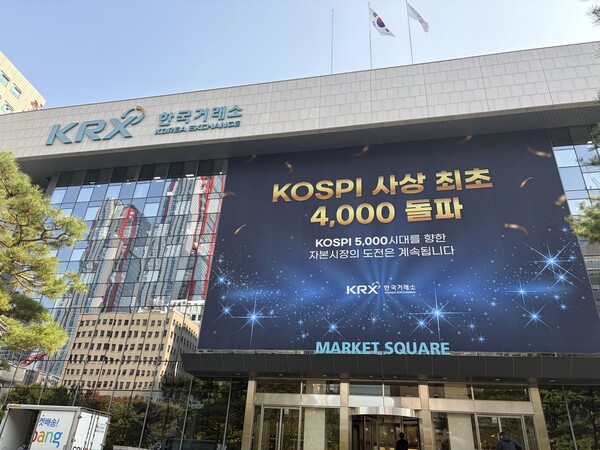
The Korea Exchange reported to financial authorities a simulation result that if delisting requirements are significantly tightened, about 230 companies could be subject to removal from the stock market by 2029.
It also plans to improve its unfair-trading monitoring and investigation system, cutting the time to detection from the current six months by about half.
The Financial Services Commission said on Monday it received work briefings from affiliated financial agencies, including the Korea Exchange, at the Government Complex Seoul annex and discussed measures such as revitalising the capital market and strengthening financial infrastructure.
The exchange reported plans to tighten delisting requirements in stages to address delays in removing weak firms, which have been cited as one cause of the "Korea Discount."
Under the proposed changes, the market-cap threshold for companies listed on the main KOSPI market, currently 5 billion won or more, will be tightened in stages and raised to 50 billion won in 2028. The revenue threshold will rise to 30 billion won by 2029.
For the KOSDAQ market, the market-cap threshold will be strengthened from 4 billion won to 30 billion won, and the revenue threshold from 3 billion won to 10 billion won.
The exchange estimated that if other variables are excluded and only the higher thresholds are applied, about 230 companies would meet the strengthened delisting conditions by 2029. That is about 8 percent of all listed firms.
The Korea Exchange said, "Compared with major overseas markets, the number of listed companies in Korea is still on the high side," adding it would consult with policy authorities on measures for early removal of various weak firms in line with principles.
FSC Chairman Lee Eok-won said there would be various objections stemming from tighter delisting standards, but asked that the exchange show determination for change and push ahead firmly.
The exchange also reported it would significantly improve the speed of its response to unfair trading by shifting from an account-by-account investigation system to an individual-based approach and strengthening investigative capabilities using artificial intelligence.
The exchange said it expects the time from detecting abnormal trading to review to be shortened from the usual six months to three months.
[Yonhap News Agency]
 Online Team
d-today@d-today.co.kr
Online Team
d-today@d-today.co.kr