
"Building agents is not a solo game. Data science teams, security teams and legal teams need to work together to build scalable agents."
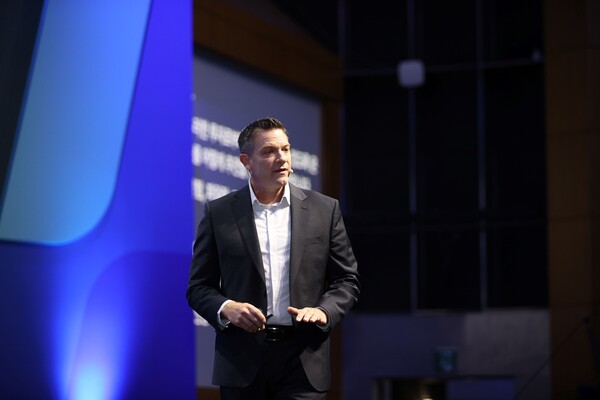
Matt Dunphy (맷 던피), a senior vice president at Dell Technologies headquarters, underscored that point in a keynote speech at the 'Dell Technologies Forum 2026' on Monday. He also shared the direction of agent evolution, focusing on two areas: complexity and autonomy.
He said productivity agents that help write emails or analyze data are the most basic stage. Headless agents that handle data cleansing and management are the next stage. Coordination agents that process service handoffs or account transfers and expert agents in which customers directly interact with commerce platforms come next. Concierge agents that orchestrate all of these flows are the top stage. He stressed that within the next 1 to 2 years every office worker will become a manager overseeing tens, hundreds or thousands of agents.
He said companies are still struggling with two problems in adopting AI. One is that it is difficult to define which tasks create the most differentiated value. The other is that they are not showing change in operating models that would convert investment into actual results.
Dunphy said "the worst choice is to just add AI on top of existing processes." He also pointed out that many companies are still not properly responding on AI infrastructure. He said that in a Dell survey, 72 percent of decision-makers at South Korean companies said their IT infrastructure was not ready to support AI. He said data cleanup remains the biggest obstacle, as it was 3 years ago.
Tokenomics was also stressed. The message was that without understanding the token economy there would be no results from AI investment.
Dunphy cited an example from Dell's internal sales organization, saying 10 percent of employees consume 90 percent of total token usage. He said if that usage pattern spreads across the entire workforce, it would no longer be manageable in terms of cost structure.
Model choice and where to run it are also important factors in cost, he said. As an example, Dunphy cited finding the time from an incident occurring to an emergency team's arrival using video surveillance data. Even to answer a simple question such as "How many seconds did it take?", about 300 million tokens are used as multiple tools and agents are involved. He said that when comparing running the same work on the cheapest model in the cloud with handling it locally on Dell's GB10 equipment, the cloud side was 10 times more expensive.
He said using the Gemini Flash model drove the cost up to $200, and using the GPT-5 model raised it even further. He said IT staff now need to become AI designers, not system administrators. Understanding workload characteristics and deciding which model to run where are core capabilities, he said.
 Chi-gyu Hwang
delight@d-today.co.kr
Chi-gyu Hwang
delight@d-today.co.kr