
[Digital Today reporter Jinju Hong (홍진주)] HoverAir’s new modular drone Versa has effectively been blocked from entering the U.S. market, IT outlet TechRadar reported on Aug. 24 local time.
The U.S. Federal Communications Commission (FCC) cancelled the certification granted to Versa, saying it had been issued in error, and deleted it from its public database.
The issue was that Versa was promoted as if it could be sold in the United States. HoverAir highlighted FCC certification last week when it unveiled Versa on crowdfunding platform Indiegogo. That wording was taken as a signal that Versa could be sold in the United States. In particular, with DJI’s new drones effectively excluded from the U.S. market since 2025, Versa appeared to have secured differentiated access rights.
The FCC then reversed its position. The FCC said importing, marketing or selling Versa in the United States would violate U.S. law and told HoverAir to immediately stop related activities. “Importing, marketing, and selling this device in the United States is a violation of U.S. law,” the FCC said, adding it had “directed that such activities stop immediately.”
The FCC explained that Versa runs afoul of its “covered list” rules. It said the Versa camera alone qualifies as a prohibited foreign-made core component of an unmanned aircraft system, and that including the flight kit would qualify as a prohibited foreign-made unmanned aircraft system. The FCC said, “The certification for this device was granted in error, and the FCC has cancelled it and removed it from the public database.”
It also left open the possibility of follow-up action. The FCC cited the possibility that HoverAir may have willfully violated the rules and said it was “reviewing additional action as this appears to be a clear, willful violation of the covered list rules.” It also said it plans to provide guidance instructing all telecommunications certification bodies to strengthen reviews. It said this would mean strengthening pre-verification so that equipment on the prohibited list is not certified again.
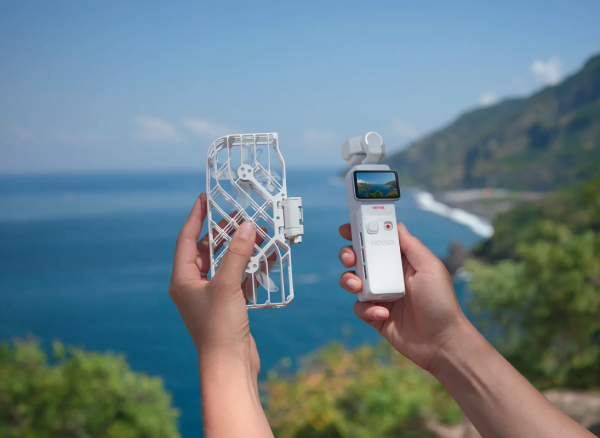
Versa was introduced as a 2-in-1 product combining a pocket gimbal camera and a drone. Detaching the wings converts it from a 230-gram autonomous flight 4K camera into a 163-gram pocket gimbal camera. It supports 4K 60-frames-per-second video, 4K HDR 30-frames-per-second 10-bit color depth, 12-megapixel photos and a 1/1.3-inch sensor. It also touts palm takeoff and landing, AI subject tracking, auto framing, and voice and gesture controls.
It can also link with HoverAir’s Beacon device to connect to a smartphone. HoverAir lists a top speed of 36 km per hour, level 5 wind resistance and a maximum flight time of 14 minutes. In gimbal camera mode, it supports a 1.64-inch rotating OLED haptic display and brightness of up to 800 nits.
The question is the product’s outlook for a U.S. launch. The Indiegogo page still lists a worldwide release and a plan to ship to backers in October 2026, and it still shows a U.S. price starting at $499. But the FCC move has made it unlikely that Versa will fly in U.S. skies for the time being. HoverAir plans to unveil Versa at the IFA electronics show in Berlin, Germany, in September.
 Jinju Hong
hongjj@d-today.co.kr
Jinju Hong
hongjj@d-today.co.kr