
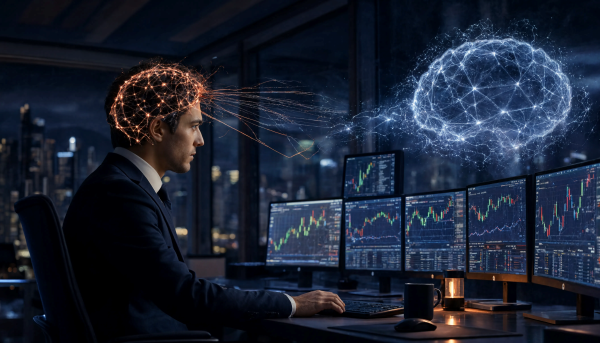
A Goldman Sachs executive leading a key artificial intelligence (AI) project warned that the spread of AI on Wall Street could weaken the thinking ability of the next generation of bankers and traders.
On Aug. 24, CNBC reported that Chris Churchman (크리스 처치먼), lead partner for Goldman Sachs' Marquee platform, said there is a risk that cognitive ability could shrink in the AI era as people hand over reasoning to models. Marquee is a digital platform that gives institutional clients access to Goldman Sachs' market data and research, risk analysis and trade execution services.
In a recent Goldman Sachs podcast, "Exchanges", Churchman said AI is moving deep into the financial industry and could shake up the talent-development structure even as it raises productivity. "There is a big risk here," he said. "If, in the AI era, we outsource our reasoning to these models, cognitive shrinkage can come in where our ability to think from first principles stops."
He said Wall Street's apprenticeship-style learning structure could weaken. Until now, junior bankers and traders have learned how to analyse and make judgments by doing repetitive tasks and supporting hands-on work, but if AI replaces much of that process, the path to becoming skilled professionals could weaken, he said. "Reasoning is still important," he said. "You need the process of weighing a problem and structuring it with logic, but right now we are delegating reasoning itself."
He said the issue is also tied to changes in hiring structures. Wall Street has already reviewed plans to use AI to reduce the ratio of junior to senior staff. As automation expands, demand for entry-level staff could decline, but how to develop future senior staff remains a task, the report said.
Churchman said Goldman Sachs also has yet to find a solution to the shift. Before joining Goldman Sachs in 2021, he was in charge of foreign exchange trading at UBS, and he is now co-chair of Goldman Sachs' Global Banking & Markets AI working group. He said banks need to find a balance that preserves both AI use and Wall Street's on-the-job training culture.
He also raised concern that tacit knowledge passed down at work could disappear. "You learn while doing the job, and a lot of knowledge is tacit, so it is not written down," he said. He stressed the need to ensure Goldman Sachs does not lose the intuitive and tacit knowledge held by its strong talent today, and that the next generation also acquires it.
He cited a junior trader's price-quoting work as an example. A junior trader builds judgment by responding to clients' price requests under the supervision of an experienced risk manager. That process can be automated, but "we can fully automate that," he said. "But then the question remains whether you can keep developing senior traders who fully understand it."
He also said system design needs clear standards. In high-risk, highly uncertain decisions, employees should make the final judgment and should not be pushed into a role of passively operating the system, he said.
Goldman Sachs is also working to apply AI to Marquee, which is used by institutional investors and hedge funds. However, the current Marquee AI platform is provided only to Goldman Sachs employees, not external clients.
He said the most difficult technical task is ensuring the factual accuracy of AI responses at the 100 percent level and leaving them in an auditable form. Consumer chatbots can warn users of possible errors, but the financial industry has little tolerance for even small mistakes. He also described a case in developing a client AI platform where software revealed its own limitations. "When we tested it hard, it was at least honest," Churchman said, adding that the AI replied, "In the end, I am better at sounding thorough than being thorough."
The remarks show that adopting AI in finance is not just an automation issue but a task that requires redesigning talent development, decision-making structures and control systems. The faster AI replaces routine work, the more precisely financial firms need to set standards on what to automate and what judgments to leave to humans.
 Seung-a Yoo
ysah@d-today.co.kr
Seung-a Yoo
ysah@d-today.co.kr