
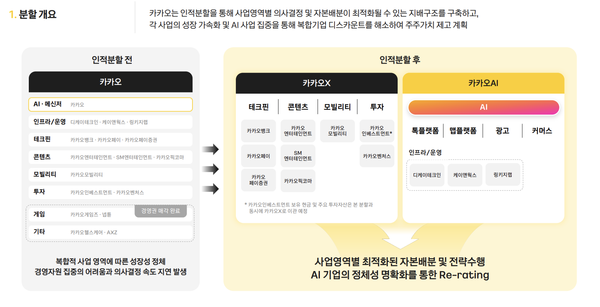
Kakao is changing how its shares are valued as it splits into KakaoAI and KakaoX. Previously, KakaoTalk and businesses such as finance, content and mobility were bundled into one company, and a so-called conglomerate discount was cited as one factor behind undervaluation because each unit’s value was not fully recognised.
Research centres at brokerages in and outside South Korea estimated Kakao Group’s potential value at 34.2 trillion won using a sum-of-the-parts valuation method, but its average market capitalisation over the past three months was about half that at 16.8 trillion won. Kakao cited the gap as one reason for the split, saying separating businesses with different characteristics would allow the market to properly value each business.
But the market’s initial reaction differed from expectations. On Aug. 21, the day the split was announced, Kakao shares fell 7.49 percent to close at 35,800 won, wiping out more than 1 trillion won in market value in a day. By Aug. 24, 5 of 11 brokerages had lowered their target prices. Samsung Securities and Meritz Securities also cut their investment ratings to "hold" from "buy".
The conglomerate discount Kakao aimed to remove is not disappearing entirely through the split. Instead, it is emerging as two issues: a net asset value discount for KakaoX and how KakaoAI’s growth prospects are assessed.
Will cutting the conglomerate discount be enough? KakaoX faces a new discount factor.
KakaoX will retain stakes in major affiliates and investment assets, including KakaoBank, Kakao Pay, Kakao Mobility and Kakao Entertainment. The company defines KakaoX not as a holding company but as a "future value investment company", but the brokerage industry takes a different view.
As the value of affiliate stakes it holds accounts for a larger share of corporate value than operating value, brokerages are valuing KakaoX by calculating the value of the affiliate stakes and investment assets and then applying a certain level of discount. In South Korea’s stock market, such companies’ net asset value is often not reflected as-is but reduced to some extent, commonly called a "holding company discount".
Samsung Securities applied a base holding company discount rate of 30 percent to KakaoX and valued it at 10.8 trillion won. It estimated that if the discount rate widens to 50 percent, Kakao’s overall fair share price could fall to 33,000 won. Meritz Securities also calculated the effective value of major KakaoX subsidiary stakes at about 11.1 trillion won, and cited as a burden on the stock the fact that domestic holding companies typically face discounts of about 30 to 60 percent. Kakao split its businesses to remove the conglomerate discount, but a different kind of discount factor has come to the fore at KakaoX.
KakaoX has already presented its response logic to such concerns. At a briefing on Aug. 21, CEO-designate Do-young Kim (김도영) presented two core indicators for KakaoX: net asset value growth and minimising the discount rate. The plan is to go beyond simply holding affiliate stakes, increase the value of held assets and also lower the discount rate assigned by the market.
On the often-compared SK Telecom and SK Square case, the company said it would build a capital allocation approach unique to KakaoX rather than follow a specific precedent as-is.
KakaoX’s asset composition being split across multiple areas is also a double-edged sword. Dependence on any single affiliate is low, but there is also an assessment that it lacks a clear "flagship asset" that could lift corporate value in the short term. Unlike SK Square, where SK Hynix stakes account for 98 percent of net asset value, KakaoX has assets dispersed across finance, content and mobility, leaving it in a situation where it must create new growth engines on its own.
Ultimately, KakaoX’s corporate value is likely to be driven by both how much it raises the value of assets it holds and how much it lowers the discount rate applied by the market. That means it needs results on both fronts: growing NAV through rising subsidiary value and new investment performance, while also lowering the discount rate through steps such as selling investment assets and returning value to shareholders.
KakaoAI faces the task of proving growth. Will it receive an AI premium?
KakaoAI is in a different phase from KakaoX. With KakaoTalk and AI, advertising and commerce businesses placed there, Kakao expects that AI companies can receive higher valuations than traditional advertising and commerce companies, which it sees as an effect of the split.
Kim said KakaoAI could be recognised for a price-to-earnings ratio of about 30 to 40 times, which the brokerage industry applies to AI businesses, if it firmly establishes its identity as an AI company. Kakao’s current PER is about 21.9 times. The problem is that the basis for assigning such a high multiple has not yet been confirmed by results.
Kakao set a goal of raising KakaoAI revenue from about 2.8 trillion won now to more than 6 trillion won in 2030, and generating more than 1 trillion won of that from AI businesses alone. It also set a target of reaching 20 million AI daily active users. But brokerages see the process of AI revenue models such as agentic commerce, advertising and subscriptions translating into actual revenue as not yet verified.
Timing is also an issue. At an earnings announcement early this year, CEO Seong-a Jeong (정신아) said it would make this year the first year of AI monetisation, but at a recent earnings announcement she delayed the outlook, projecting that full-scale monetisation would be possible from 2027.
X is about capital allocation, AI about monetisation. Stock drivers change after the split.
The brokerage industry’s view of the split ultimately converges on the different tasks facing the two companies. KakaoX can reduce the NAV discount only if it links efforts to raise affiliate corporate value and new investment performance to shareholder returns. KB Securities assessed that clear capital allocation principles and an active shareholder return policy are needed for that.
KakaoAI needs to connect the KakaoTalk user base to AI service use and to advertising, commerce and subscription revenue to build a basis for receiving the high valuations applied to AI companies.
Samsung Securities said Kakao’s combined corporate value after the split would ultimately be determined between the extent of KakaoAI’s re-rating and the extent of KakaoX’s discount. For now, it said, the possibility of a KakaoX discount is relatively clear, while any KakaoAI premium could vary depending on future business performance.
Ultimately, for this spin-off to lead to a share-price re-rating, the re-rating effect generated at KakaoAI needs to exceed the discount burden applied to KakaoX. KakaoAI needs to secure a growth premium as an AI company, and KakaoX needs to raise NAV through capital allocation and shareholder returns while also managing the size of the discount.
 Ho-jeong Lee
lhj@d-today.co.kr
Ho-jeong Lee
lhj@d-today.co.kr