
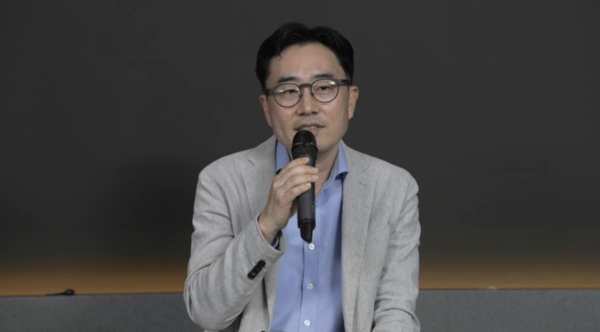
Kim Do-young (김도영), nominee for CEO of KakaoX, said the background to splitting the company into two is an assessment that a significant amount of management time is tied up with subsidiaries. Over the past five years, more than 80 percent of the Kakao board’s non-routine decisions and internal investment review items over the past year have been related to subsidiaries rather than the Kakao parent, preventing Kakao’s leadership from moving quickly to respond in the era of artificial intelligence (AI).
Kim gave the explanation at a press briefing on Aug. 21 on the planned spin-off. He said 23 of the Kakao board’s non-routine decisions over the past five years were subsidiary agenda items, about 85 percent of the total. He said 84 percent of 32 internal investment review items led by management over the past year were also related to subsidiaries.
Kim said the items were not about companies that would grow to match Kakao in the future, but focused on resolving capital support or lending issues for subsidiaries facing difficulties. During that time, the capital market demanded that Kakao commercialise business-to-consumer (B2C) AI services and clarify profit models, but management resources at the parent were used for urgent matters rather than important ones, he said.
Kakao held a board meeting on the day and approved a plan to split through a spin-off into newly created KakaoAI and surviving KakaoX. The split ratio, based on net asset book value, is 0.36 for KakaoAI and 0.64 for KakaoX.
The scale of Kakao’s subsidiaries is also shown in its half-year report. As of June 30, the Kakao corporate group had 152 affiliates at home and abroad, including 92 domestic affiliates, the report said. Kakao said it has been winding down non-core businesses and reducing the number of affiliates over the past two years.
After the split, the boards of the two companies will handle different agenda items only. Kim said KakaoAI will be a business company centred on KakaoTalk and AI technology and will hold only subsidiaries that support infrastructure and services, while KakaoX will be an investment company holding stakes in all affiliates and taking on the role of supporting and investing in subsidiaries.
With agenda items such as capital support or lending for subsidiaries moving to the KakaoX board, only decisions related to AI services and advertising and commerce will remain with the KakaoAI board, he said. Jung Shin-a (정신아), nominee for CEO of KakaoAI, also said, "This split separates the significant role of managing subsidiaries and establishes a business structure that allows us to focus only on core businesses."
CA council to be abolished, no plan to convert to a holding company
After the split, the CA council, which has served as the group’s control tower, will not be maintained. Kim said a joint organisation like the existing CA council is no longer necessary. He said the council existed because Kakao had been responsible for both KakaoTalk-based businesses and subsidiary management at the same time, and once the two roles are separated, the basis for it disappears.
Kim also ruled out any plan to convert KakaoX into a holding company. "I can say clearly there is absolutely no plan to convert to a holding company," he said. He added that Kakao Enterprise will start as a KakaoX subsidiary immediately after the split to meet qualified split-off requirements, but the board will discuss moving it under KakaoAI given business relevance.
A criticism raised at the briefing was that the split ratio for KakaoAI was set low. Kim said, "The spin-off ratio is allocated, under relevant regulations, according to the ratio of net asset value of the assets each corporation will hold." He added that the two companies’ consolidated operating profit is at a similar level. While the asset book value split is 0.36 to 0.64, their profit-generating ability is equal, he said.
Kim also acknowledged that allocation based on net asset value is bound to diverge from corporate value, but said there will be no loss in shareholder value if the ownership ratio is maintained because the market will separately re-evaluate the companies at the time of relisting. Stakes held by founder Kim Beom-su and K Cube Holdings will also be allocated to both companies at the same ratio without changes in ownership before and after the split.
KakaoX will pay a priority dividend of 30 percent of dividend income from subsidiaries. If investment gains arise, it will return 30 percent as a special dividend and reinvest the remaining 70 percent. About 300 billion won, or roughly 30 percent of the amount remaining after subtracting investment principal and taxes from the 1.6 trillion won proceeds from Kakao Investment’s sale of its Dunamu stake, will be used for share buybacks and cancellation in connection with the split.
 Dae-geon Seok
d2dg@d-today.co.kr
Dae-geon Seok
d2dg@d-today.co.kr