
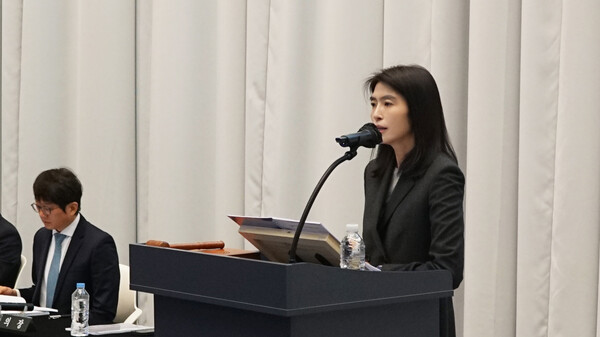
Kakao will separate its Kakaotalk and artificial intelligence (AI) businesses and turn them into a separately listed company. The move follows a view that the market valuation of Kakao does not fully reflect the value of its businesses. It aims to speed up growth and win a proper valuation through the split.
Kakao said on Thursday its board approved an agenda item to carry out a human split into a newly established company, KakaoAI, and a surviving company, KakaoX. A human split distributes shares of the new company to shareholders of the surviving company at the same ratio, differing from a physical split in which the surviving company holds a 100 percent stake in the new company. Existing shareholders will receive shares in both firms according to a split ratio set on net asset book value: 0.36 for KakaoAI and 0.64 for KakaoX.
Kakao cited resolving undervaluation as the rationale for the split. Kakao said that as of August 2026, the average consensus of sum-of-the-parts (SOTP) valuations from research centers at domestic and overseas securities firms put Kakao Group's potential value at 34.2 trillion won. That compares with an average market capitalisation of 16.8 trillion won over the past three months, a difference of 17.4 trillion won. The company said the market has applied different valuation standards to its Kakaotalk and AI-centered platform business and its tech-finance, content and mobility businesses, and that splitting the two areas would allow each to be properly valued.
The schedule calls for an extraordinary general meeting of shareholders on Dec. 17, a split date on Jan. 1, 2027, and the relisting of KakaoAI and the change listing of KakaoX on Jan. 27.
Kakaotalk, from messenger to an 'AI interface'
KakaoAI's stated goal is to transform Kakaotalk from a chat app into a personalised AI gateway. When users state what they want in messages, an AI agent links them to necessary services and specialist agents and handles steps from discovery to recommendations, purchases and payments. Kakao outlined a plan to evolve Kakaotalk into an "agentic AI interface" that understands the intent and context of each of its about 50 million users.
Kakao said it aims to secure more than 20 million AI daily active users by 2030 and increase time spent on the platform by more than 50 percent. It said longer time spent would bring AI advertising, agentic commerce and subscription revenue. It set a goal of achieving KakaoAI revenue of more than 6 trillion won in 2030, based on annual average revenue growth of about 20 percent.
It plans to raise AI revenue to a double-digit share of total revenue by 2028 and to surpass 1 trillion won in 2030. KakaoAI will hand over to KakaoX the role of supporting and managing the growth of subsidiaries and will focus on expanding Kakaotalk and AI services. Kakao CEO Jeong Shin-a (정신아) has been tapped to lead the unit, and operating subsidiaries such as DK Techin and K and Works will be placed under it.
The surviving company, KakaoX, is positioning itself as a future-value investment company. It will oversee tech-finance businesses including KakaoBank and KakaoPay, as well as Kakao Entertainment, SM Entertainment and Kakao Mobility. It also cited crypto assets, physical AI and global fandom as areas under review for new investments. KakaoX will use about 2.3 trillion won raised through asset securitisation and about 4.1 trillion won held by subsidiaries as investment resources. It aims to achieve an annual average growth rate of 13.3 percent in revenue from major businesses through 2030 and build revenue of more than 10 trillion won. Kim Do-young (김도영), CEO of Kakao Investment and head of the group investment strategy office at the Kakao CA consultative body, has been tapped as CEO.
Kakao answers with shareholder returns... to pursue cancellation of 300 billion won of treasury shares, return 20 to 35 percent of FCF
The company also disclosed shareholder return figures. KakaoAI will use 20 to 35 percent of standalone adjusted free cash flow (FCF) as a basic source for shareholder returns. KakaoX will use 30 percent of dividends from subsidiaries and 30 percent of investment gains as return resources. It also unveiled a plan to buy back and cancel treasury shares worth 300 billion won using gains from the sale of Dunamu.
The split extends restructuring work Kakao has pursued for more than two years. Kakao has streamlined non-core businesses and reduced the number of affiliates while revamping governance around growth businesses. Kakao said that as the scale of its business has grown and complexity has risen, a single decision-making system has made it difficult to execute business-by-business strategies with speed, and that this led to the split.
Kakao's response is information disclosure. The two companies will each form a separate board suited to the nature of its business. After the split, they will regularly disclose key indicators and capital allocation principles including revenue and profitability, investment execution and shareholder returns, and expand domestic and overseas investor relations and shareholder communication programs. Kakao said it expects that as performance and financial information accumulate independently by business, business value will also be evaluated more clearly. Employment, working conditions, welfare benefits and business continuity will remain unchanged after the split.
Jeong said, "This split is a decision for Kakao to transition to a structure of speed and responsibility suited to the AI era." Founder Kim Beom-su (김범수) said, "As the AI era requires a different level of agility, we will redesign the growth structure with two engines, KakaoAI and KakaoX." The split plan will be finalised after approval at the extraordinary shareholders meeting in December.
 Seok Dae-geon
d2dg@d-today.co.kr
Seok Dae-geon
d2dg@d-today.co.kr