
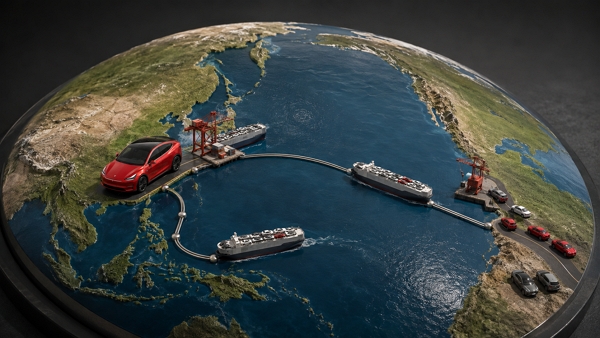
[DigitalToday reporter Choi Jae-won] An analysis says Chinese automakers are rapidly expanding overseas markets such as Southeast Asia and Latin America to avoid high U.S. tariff barriers, putting the competitiveness of traditional U.S. and Japanese automakers back to the test.
On Aug. 19 local time, electric-vehicle outlet Cleantechnica said Chinese companies are increasing exports and local production in other countries with high growth potential rather than focusing on entering the U.S. market. It pointed out that if incumbents that are slow to shift to EVs also lose their overseas sales bases, their long-term competitiveness could weaken.
The overseas expansion of Chinese EVs is also clear in the data. According to the International Energy Agency (IEA), China's EV exports topped 2.5 million in 2025, doubling from a year earlier. Southeast Asia's EV imports also exceeded 300,000, rising by more than twofold, and most were made in China. Overseas sales of Chinese EVs rose 130 percent in Southeast Asia and 55 percent in Latin America. In the first half of this year, China's overall auto exports rose 65 percent from a year earlier, while EV exports increased by more than 120 percent.
The outlet said this trend could put pressure on incumbents such as Toyota, Ford, GM and Stellantis. It argued that if overseas consumers shift toward price-competitive Chinese EVs, sales of internal combustion vehicles that these companies have relied on and their economies of scale could be shaken at the same time. It stressed that maintaining competitiveness in overseas markets is even more important for Japan's auto industry, where the domestic population is declining.
Ford was cited as a representative case of adjusting an EV strategy. Last year, Ford ended production of the F-150 Lightning and cancelled three plans, including a large electric pickup and electric commercial vans for the United States and Europe. The size of special items tied to restructuring the related EV business was about $19.5 billion (about 27.18 trillion won). Ford is not giving up on its EV business itself, and is reallocating investment to a low-cost universal EV platform and hybrids.
Chinese companies have also begun a push in Japan itself. BYD in July launched the RACCO, an EV developed to meet Japan's kei car standards. Amid this situation, Japanese companies are also responding with vehicles such as the Mazda6e. The Mazda6e is an EV jointly developed by Mazda and Changan Automobile and produced by their Changan Mazda joint venture in China for export to Europe and other markets. It is closer to a cooperation model combining China's electrification technology and Japanese brand design and driving know-how than a simple badge swap.
The key is not only whether Chinese cars enter the U.S. Chinese companies are already quickly pre-empting overseas EV markets such as Southeast Asia and Latin America. That has made it quite important for U.S. and Japanese companies to protect their existing export markets. They also face the task of boosting EV competitiveness. These two challenges are expected to shape the future global auto market.
 Choi Jae-won
ittt_0801@d-today.co.kr
Choi Jae-won
ittt_0801@d-today.co.kr