
[DigitalToday Seung-a Yoo, intern reporter] U.S. President Donald Trump said the artificial intelligence (AI) industry could be made bigger than the internet. He said regulation must not stand in the way of industrial growth for U.S. competitiveness against China.
On Aug. 19 (local time), foreign media including blockchain outlet Decrypt reported that Trump stressed the need for AI regulation and expanded infrastructure at a White House event with cryptocurrency industry officials and financial regulators. The event was held ahead of the first Innovation Advisory Committee meeting under the U.S. Commodity Futures Trading Commission (CFTC).
Trump described AI as a core U.S. strategic industry. "Regulate, but it has to be in a way where the companies can continue to keep the edge," he said. "Regulation can’t suffocate a very important industry," he said. "AI is bigger than the internet, and it could be the biggest industry that anybody’s ever seen," he added.
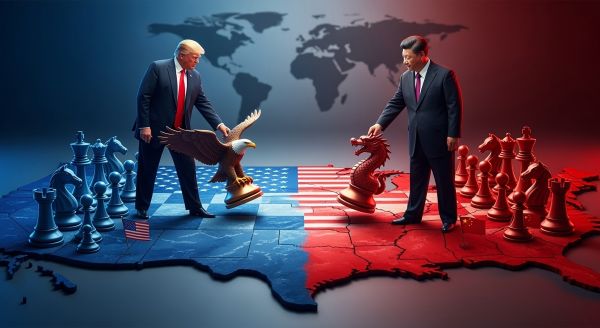
The remarks come as the U.S. government accelerates AI infrastructure projects with technology competition with China in mind. Trump pointed to China as the United States' closest competitor. He also mentioned the possibility that AI could be a main agenda item during a planned Sept. 24 visit by Chinese President Xi Jinping.
◆ Expanding AI datacentres... companies to bear power burden
Trump also addressed controversy over rising electricity demand from the spread of datacentres. He stressed an approach in which AI companies directly build power plants for datacentres rather than rely on an ageing power grid.
"The grid is old and tired and weak," he said, adding that companies are building the best power plants in the world. "They’re not using electricity from the existing grid, they’re using completely new electricity," he said, explaining that surplus power is instead being supplied to the grid.
Major big tech companies have already formalised their commitment to bear power infrastructure costs. Amazon, Google, Meta, Microsoft (MS), OpenAI, Oracle and xAI signed the White House's "Pledge to Protect America's Power Bill Payers" in March and agreed to cover the costs of new generation facilities and infrastructure needed for datacentres.
Trump urged local governments to actively seek to attract AI factories and datacentres. He said that if you are a mayor or governor, you would want them when there is an opportunity to bring in a large factory, an AI factory or a datacentre, stressing that the job and tax revenue effects are very large. He also said many recently built datacentres are "very beautifully designed."
◆ Rising backlash against datacentres... power bills and environmental burden in focus
But local backlash over datacentres is also growing. Trump told reporters shortly after the crypto event that the industry may "need a little bit of PR help." Opposition is spreading around issues including higher electricity bills, water use and environmental impact.
At least 37 people have been arrested during protests against datacentres so far this year, and legislatures in 15 states reviewed measures to halt or pause datacentre development.
Moves to tighten regulation are also emerging. The day before, Pennsylvania Governor Josh Shapiro signed an executive order including new requirements for developers to bear costs that large datacentres shift onto the power grid. He described it as the "strictest" standard in the industry and criticised "speculators" who tried to "harass" local officials into granting approvals.
Ahead of November midterm elections, support for attracting datacentres is becoming political attack material regardless of party. Trump said regions or states that refuse to host datacentres will be "left out." It is similar in context to his reaction this summer when New York Governor Kathy Hochul signed the United States' first statewide datacentre moratorium.
◆ Local concerns persist despite tax revenue effects
Datacentres bring substantial tax revenue effects to local governments. In Loudoun County, Virginia, datacentres generated more than a third of the county's general fund revenue in the last fiscal year. State and local governments have also provided tax benefits to the industry.
According to Virginia tax authorities, the amount the industry saved through sales tax exemptions in the last fiscal year reached $1.9 billion, about 2.64 trillion won.
Datacentres themselves have existed for decades, but recent AI datacentres differ in that they are much larger and require more electricity. A Gallup poll in March found that 7 in 10 Americans oppose datacentre construction in their area.
The AI and tech industry is also responding to worsening public sentiment and the spread of opposition to datacentres. In January, Microsoft President Brad Smith said the company would be "a good neighbor" in communities where it builds, owns and operates datacentres. Earlier this month, Meta announced plans to create a $1.0 billion, about 1.4 trillion won, "Future Is For Everyone" fund to support communities hosting datacentres.
The financial sector is also increasingly reflecting local backlash in decisions on funding. As of the first quarter this year, more than 75 datacentres worth about $130.0 billion, about 180.7 trillion won, were tallied as facing local opposition.
Trump also told reporters that he is scheduled to meet AI industry leaders next week.
As a result, U.S. AI policy is developing in a structure where it pushes deregulation and expands AI infrastructure with competition with China in mind, while local checks grow around power grid costs and environmental burdens. How the United States manages local conflicts over datacentres while maintaining a growth-first stance is expected to emerge as a key variable.
 Seung-a Yoo
ysah@d-today.co.kr
Seung-a Yoo
ysah@d-today.co.kr