
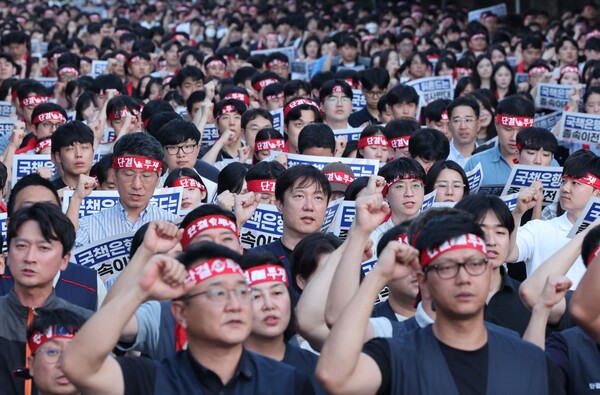
As speculation grows that the government is close to announcing a second plan to relocate public institutions outside Seoul, the finance sector is on edge. After three major state-run banks including Korea Development Bank, IBK Industrial Bank of Korea and Export-Import Bank of Korea, financial authorities such as the Financial Services Commission and the Financial Supervisory Service are also being mentioned as potential relocation targets. Financial sector labour groups are raising the level of protest, pledging an all-out campaign to block any relocation and warning of a general strike.
The finance sector on Aug. 17 pointed to growing expectations that the government could announce as early as Aug. 25 the broad framework for additional relocations of central administrative agencies and a second round of public-institution relocations. Recently, the possibility has been discussed more concretely of moving the FSC from the Government Complex Seoul to Sejong and relocating KDB, IBK and Eximbank outside Seoul. The FSS is also being cited as a possible relocation target.
The government has not officially finalised the institutions or regions subject to relocation. The Ministry of Land, Infrastructure and Transport previously said it was reviewing a second round of public-institution relocations, but said specific institutions and regions had not been decided. As a result, whether individual financial institutions will move and where they would go are expected to become clearer only after the government releases its final plan.
FINANCE SECTOR CORE INSTITUTIONS FLOATED FOR RELOCATION
Tensions are rising in the finance sector as the range of institutions being discussed as relocation targets expands.
The institutions most directly affected are the three major state-run banks. KDB, IBK and Eximbank all currently have their headquarters in Seoul. As the possibility of relocating these institutions outside Seoul has been raised repeatedly in recent discussions on the government's second relocation plan, internal opposition is also intensifying.
The possibility of moving the FSC to Sejong is also being discussed. If the FSC relocates to Sejong, the central ministry in charge of financial policy would leave Seoul, and significant changes are expected in how it works with financial companies. As even the FSS, which works closely with the FSC, is being mentioned as a possible relocation target, attention is also focused on the possibility of financial authorities leaving Seoul.
The Bank of Korea is also not free from talk of a move to Sejong. However, including the central bank, some financial institutions face structural limits that make it difficult to relocate headquarters based only on a government decision. The current Bank of Korea Act stipulates that its main office must be in Seoul. The Act on the Establishment of the Financial Services Commission also stipulates that the FSS' main office must be in Seoul. The Korea Development Bank Act, the Industrial Bank of Korea Act and the Export-Import Bank of Korea Act also specify that each bank's headquarters must be in Seoul. To fully move their headquarters and main offices outside Seoul would require revisions to relevant laws first.
The Korea Deposit Insurance Corporation is not an exception. Its union held a research presentation on Aug. 11 and argued that KDIC should be excluded from across-the-board relocation targets because it is a financial safety net institution that responds to financial company failures and financial crises. It said that with financial company headquarters and financial authorities concentrated in Seoul, greater physical distance could disrupt detection of early signs of trouble, cooperation among institutions and swift decision-making during a crisis.
It said that in a digital environment, deposit outflows and market instability can spread within hours, making accessibility to the financial hub important. The current Depositor Protection Act also stipulates that KDIC's main office must be in Seoul.
UNION OPPOSITION GAINS MOMENTUM
As discussions show signs of becoming more concrete, opposition from financial sector labour groups is also intensifying.
Unions at KDB, IBK and Eximbank on Aug. 11 held a rally near KDB's headquarters in Yeouido, Seoul, under the banner of an "all-out struggle resolution rally to block relocation of state-run banks". It was the first time the three state-run bank unions took joint action over the relocation issue, and organisers estimated about 2,000 people attended.
The Korean Financial Industry Union plans to launch a general strike on Sept. 4. Blocking relocation was included among this year's key demands in sector-wide central bargaining, along with introducing a 4.5-day workweek and raising real wages. In a strike authorisation vote held on Aug. 12, 96.1 percent of voters supported the strike. Ahead of the walkout, it plans to hold a resolution rally in Yeouido, Seoul, on Aug. 28.
The financial union's NH Nonghyup branch previously held a rally last month and said it opposed moves to include even private cooperatives, beyond public institutions, as relocation targets.
Although the government's detailed relocation plan has not been made public, opposition is already spreading across the finance sector. Depending on how extensively the announced plan includes financial institutions such as financial authorities and state-run banks, conflict over relocation is expected to intensify further.
A finance industry official said, "As various forecasts related to relocation are coming out more concretely, anxiety among employees is also growing." The official said, "Especially when young employees start talking about housing, family and children's education, it leads to a situation where they end up considering quitting or even living apart from their families." The official added, "Considering these practical problems, it is also questionable whether there is any real benefit to pushing relocation."
Another finance industry official said, "There is even talk that follow-up procedures such as preparing relevant legislation could proceed quickly." The official said, "As a result, opposition led by unions is unlikely to subside easily going forward."
 Ji-young Lee (이지영)
ljy@d-today.co.kr
Ji-young Lee (이지영)
ljy@d-today.co.kr