
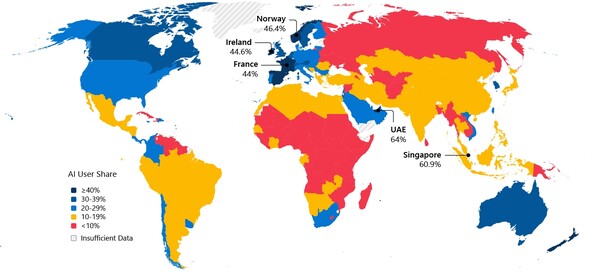
[Digital Today reporter Chi-gyu Hwang] Microsoft think tank The AI Economy Institute on Monday released an “AI Diffusion Report: A Widening Digital Divide” analysing AI adoption in the second half of 2025 and digital divide issues.
The report said global generative AI adoption stood at 16.3 percent in the second half of 2025, up 1.2 percentage points from the first half.
But the gap in AI adoption between the Global North, centred on advanced countries, and the Global South, centred on emerging economies, widened. It showed signs of a deepening regional digital divide depending on early infrastructure investment.
By country, early investors in digital infrastructure such as the United Arab Emirates at 64.0 percent, Singapore at 60.9 percent, Norway at 46.4 percent and Spain at 41.8 percent continued to lead adoption. The United States maintained the world’s highest level in absolute usage, but its per-capita usage rate was lower than in small digital-economy countries with concentrated infrastructure, placing it 24th globally. South Korea’s global ranking jumped to 18th.
The report also analysed that the open-source AI platform DeepSeek is lowering economic and technical barriers to entry and reshaping the global landscape.
Microsoft said the changes suggest that “accessibility” is driving AI diffusion. It recommended ensuring that future innovation spreads in a way that narrows gaps as a key task for the global ecosystem.
In the second half of last year, global generative AI adoption reached a record level, with 1 in 6 working-age people using AI. Microsoft assessed the figure as a very meaningful advance given that generative AI remains an early-stage technology that only recently entered the mainstream market.
Regional imbalances also became clearer. The Global North adoption rate of 24.7 percent was nearly twice that of the Global South at 14.1 percent, and the gap widened to 10.6 percentage points in the second half from 9.8 percentage points in the first half of 2025. In the top ranks, the United Arab Emirates and Singapore held first and second place, followed by Norway, Ireland, France and Spain.
South Korea recorded the most standout growth among countries surveyed in the second half, rising 7 places to 18th. The usage rate surpassed 30 percent of the working-age population, and cumulative growth since October 2024 exceeded 80 percent, far outpacing the global average of 35 percent and the United States at 25 percent. The report analysed that South Korea’s rapid growth resulted from three drivers working together: national policy, improved model performance and a popular cultural phenomenon.
Technically, a sharp improvement in Korean-language capabilities of frontier models played a key role. The latest models such as GPT-4o and GPT-5 posted outstanding results on the Korean College Scholastic Ability Test, or CSAT, benchmark, increasing their usefulness in practical settings including professional work and education.
The report said South Korea’s case is a key indicator that as a model’s language capabilities become more sophisticated, actual usage can rise in proportion. It also suggests that other language regions with limited training data could see AI adoption expand sharply as local-language model performance improves.
It also analysed that popular cultural phenomena such as “Ghibli-style” image generation triggered an influx of new users, and that these initial experiences showed signs of taking hold as long-term usage beyond a temporary fad. Microsoft said consumer-level interest, combined with government policy and technological advances, became a key driver behind the rise in AI usage in South Korea.
The rise of the open-source AI platform DeepSeek was also seen as a major change. DeepSeek is characterised by publishing model weights under an MIT licence and offering free services, lowering barriers to entry in emerging markets.
Usage surged in China, Russia and across Africa, and DeepSeek usage in Africa was estimated to be 2 to 4 times higher than in other regions. By contrast, adoption remained minimal in countries where services are already stably established, such as South Korea and Israel, showing clear regional differences.
Microsoft said, from a governance perspective, DeepSeek’s rise suggests that global AI adoption decisions depend not only on model quality but also on “accessibility and availability.” As open models spread rapidly, the need for discussion on AI safety standards and management systems is also growing because the structure is relatively difficult to supervise or control. The report further analysed that the next 1 billion AI users could form primarily in the Global South, where open-source innovation has become possible.
 Chi-gyu Hwang
delight@d-today.co.kr
Chi-gyu Hwang
delight@d-today.co.kr