
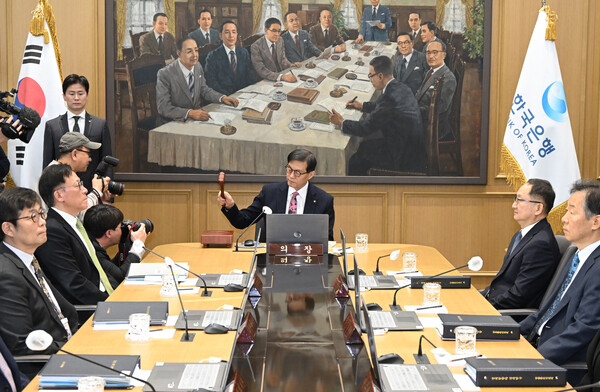
[Digital Today reporter Ji-young Lee] The Bank of Korea's Monetary Policy Board met on Feb. 26 and held the base interest rate at 2.5 percent for a sixth straight meeting. It took into account inflation continuing a stabilising trend near the target level, growth improving more than expected and persistent financial stability risks.
The board said on Feb. 26 it will keep the base rate at the current level until the next monetary policy decision. It explained that maintaining the current level while checking domestic and external policy conditions is appropriate, as inflation is continuing a stable trend around the target level, growth is improving more than expected and financial stability risks are persisting.
The board said the domestic economy is sustaining an improvement trend, supported by a recovery in consumption and strong exports. Employment continued to rise, led by the services sector. While sluggish construction investment is expected to continue, the rise in exports and facility investment is projected to widen more than initially expected, backed by an ongoing recovery in consumption, a boom in the semiconductor cycle and solid global economic growth.
Accordingly, it forecast this year's growth at 2.0 percent, above the 1.8 percent presented in November last year. It cited the semiconductor cycle, the pace of domestic demand recovery, major economies' monetary and fiscal policy and U.S. tariff policy, and geopolitical risks as factors posing upside and downside risks.
It projected this year's consumer inflation and core inflation at 2.2 percent and 2.1 percent, respectively. That is slightly above the November forecasts of 2.1 percent and 2.0 percent. The board said cost pressures for some electronic device items, among others, were reflected. It said the future inflation path is likely to be affected by international oil prices, the exchange rate, domestic and overseas economic conditions and the government's inflation-stabilisation measures.
In financial and foreign exchange markets, volatility in key price variables increased. The won-dollar exchange rate fluctuated, influenced by supply-and-demand factors such as residents' overseas securities investment and foreigners' stock selling, as well as moves in currencies of neighbouring countries such as the yen, before falling sharply recently.
Yields on Korean Treasury bonds rose sharply on weaker expectations for rate cuts and supply-and-demand burdens, before partially retracing. Stock prices continued a steep rise, supported by expectations of improved earnings in major industries and hopes for capital market system improvements, but volatility increased depending on moves in global stock markets.
Household loans posted only a slight increase as the government's stance on tightening macroprudential policy continued. Housing prices in the Seoul metropolitan area rose at a slower pace due to the impact of government measures, but the board said it needs to watch developments further.
The board said it will seek to ensure that inflation can stabilise at the target level over the medium term while monitoring the growth trend. It added that all 7 board members supported the decision to hold the base rate.
 Ji-young Lee
ljy@d-today.co.kr
Ji-young Lee
ljy@d-today.co.kr