
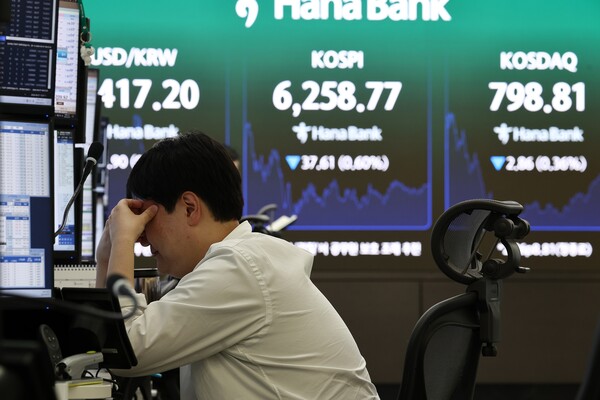
South Korean stocks this week are expected to move in a pattern that checks whether flows are normalising after the steep drop. Concentration in semiconductors and pressure from unwinding leveraged investments are easing. But U.S. inflation data could rekindle rate worries.
According to the Korea Exchange, the KOSPI on Aug. 7 closed down 37.61 points, or 0.61 percent, at 6,258.77. The Kosdaq also ended down 2.86 points, or 0.36 percent, at 798.81. Middle East tensions and weakness in large semiconductor stocks dragged the KOSPI lower, but the one-way dumping seen during the recent plunge has eased somewhat.
U.S. stocks rose as worries about rate hikes eased on signs of cooling employment. On Aug. 7, the Dow Jones Industrial Average ended up 0.28 percent at 54,036.93, the S&P 500 gained 0.62 percent to 7,757.64 and the Nasdaq rose 1.30 percent to 26,690.62.
The most important variable this week is U.S. inflation. U.S. July CPI will be released on Aug. 12, producer prices on Aug. 13 and retail sales on Aug. 14. Releases are also scheduled for those dates in the calendars of the U.S. Bureau of Labor Statistics and the Commerce Department, respectively.
The industry expects July CPI and core CPI to come in around 3.5 percent and 2.5 percent year on year, likely similar to or slightly lower than the previous month. Still, with international oil prices having moved again during the recent conflict between the United States and Iran, it is important whether higher energy prices have spread to other prices such as services.
If inflation stays within expectations or comes in lower, worries about additional rate hikes could ease further alongside the recent U.S. employment slowdown. After the U.S. jobs report on Aug. 7, the market-implied chance of a September rate hike fell to around 44 percent.
If inflation comes in higher than expected, U.S. Treasury yields and the dollar could rise again, weighing on domestic growth stocks and foreign flows.
In South Korea, how much concentration in semiconductors has normalised is key. Samsung Electronics and SK Hynix accounted for 58.9 percent of KOSPI market capitalisation as of June 25, but that fell to 46.3 percent on Aug. 6. That suggests a significant part of the demand that had been excessively concentrated in the two stocks over a short period has eased.
The influence of single-stock leveraged exchange-traded funds is also shrinking quickly. Average daily trading value in related products plunged to about 600.0 billion won on Aug. 6 from 75.0 trillion won before the increase in the minimum deposit requirement.
Outstanding margin loans also fell to 27.6 trillion won on Aug. 5 from 37.5 trillion won on June 24. That is a point where additional forced selling and mechanical selling pressure could be lower than before.
After leveraged ETF regulations, changes also appeared in actual retail flows. This year to date, individual investors have net bought 16.1 trillion won of single-stock leveraged ETFs, while net selling 10.2 trillion won on the Kosdaq.
But from July 31, when the stronger minimum deposit measure took effect, through Aug. 6, individuals net sold about 1.2 trillion won of single-stock leveraged ETFs.
That has also put the spotlight on whether funds could move back to the Kosdaq. The Kosdaq has fallen in the recent plunge to around the 800 level, its 120-day moving average. The maximum decline from the July peak was 47.4 percent, larger than 44.2 percent during COVID-19 in 2020.
As regulation of leveraged products eases the concentration of funds in large semiconductor stocks, foreigners have net bought about 5.0 trillion won on the Kosdaq this year through Aug. 6. Tighter delisting requirements and policies to improve the Kosdaq market structure are also cited as positive factors for medium- to long-term flows.
After the easing of semiconductor concentration, leading stocks could rebound again and lift sectors where share prices have risen less relative to earnings as well.
Ultimately, the key question for the market this week is whether domestic flow normalisation can continue without U.S. CPI stoking rate worries.
If the burden from leveraged semiconductor trades and margin loans continues to ease and buying spreads to non-semiconductors and the Kosdaq, the rebound since last month's plunge could continue in a more stable form. If U.S. inflation strengthens again, high volatility could persist for some time.
Lee Kyung-min (이경민), an analyst at Daishin Securities, said volatility will also ease as flow concentration driven by leveraged trading abates. He said he expects laggards that are undervalued relative to earnings to rise alongside semiconductors as they re-establish themselves as leading stocks.
Kwon Beom-seok (권범석), an analyst at Samsung Securities, said the Kosdaq has moved into an attractive price range from a long-term investment perspective after the recent correction. He said the single-stock leveraged ETF regulation could ease flow concentration into large stocks.
 Oh Sang-yup
yub@d-today.co.kr
Oh Sang-yup
yub@d-today.co.kr