
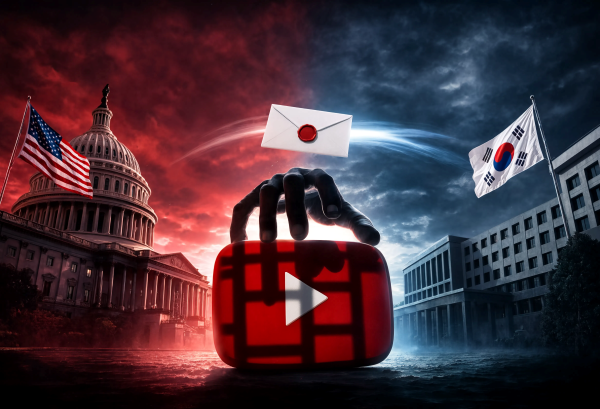
Republican lawmakers on the U.S. House Judiciary Committee conveyed concerns to the South Korean government, saying South Korea's regulation of online false information could infringe freedom of expression.
On Aug. 6, CNBC reported that Republican lawmakers, including House Judiciary Committee Chairman Jim Jordan (짐 조던), sent a letter to South Korea's Korea Communications Commission seeking an explanation of the law's enforcement plans.
The provision at issue is an amendment to the Information and Communications Network Act, often dubbed a "fake news law". It passed the National Assembly last December and took effect on July 7, 2026. The amendment allows the government to impose administrative fines when news organisations and content publishers with at least 100,000 subscribers intentionally spread false information. Violations can draw penalties of up to 1 billion won.
The Republican lawmakers said the amendment does not clearly define the scope of false information, allowing the government to use it to target politically disadvantageous views. "This amendment is a significant threat to online speech and expression, and it enables the Korea Communications Commission to punish U.S. companies and users even for exercising their constitutional rights," they said in the letter.
Representative Scott Fitzgerald (스콧 피츠제럴드) said in a separate statement that South Korea's so-called false information law is vague and overly broad in scope, leaving significant room for abuse. He added that no foreign government has the authority to pressure U.S. companies into censoring constitutionally protected speech, and that Congress would continue to scrutinise attempts by foreign governments to export censorship.
The letter was signed by Jordan as well as Fitzgerald, Representative Darrell Issa (대럴 아이사) and Representative Michael Baumgartner (마이클 바움가트너). They argued the amendment targets U.S. companies, including Alphabet's YouTube.
The South Korean government has said the amendment is meant to protect citizens from harm caused by illegal, manipulated false information. The chair of the Korea Communications Commission said the same in a July statement. Opposition has continued in South Korea, led by journalists and civil liberties groups. The South Korean Embassy in Washington did not immediately respond to a request for comment.
The letter comes as trade friction between the United States and South Korea grows. U.S. President Donald Trump last week imposed new tariffs on dozens of countries, including South Korea, over allegations of forced labour practices. The House Judiciary Committee also issued a report in July saying the South Korean government discriminates against U.S.-based online retailer Coupang. Coupang conducts most of its business in Asia.
Under Jordan, the House Judiciary Committee has repeatedly addressed concerns that overseas regulation restricts U.S. free speech and innovation. It has also issued multiple reports on the European Union's Digital Services Act. The online content regulation framework adopted in 2022 became an occasion for tighter oversight of U.S. companies including Google and Anthropic.
The Republican lawmakers view South Korea's amendment as directly linked to the Digital Services Act. "South Korea appears to have followed the EU precedent and introduced legislation that directly copies the Digital Services Act," they wrote in the letter.
 Seung-ah Yoo
ysah@d-today.co.kr
Seung-ah Yoo
ysah@d-today.co.kr