
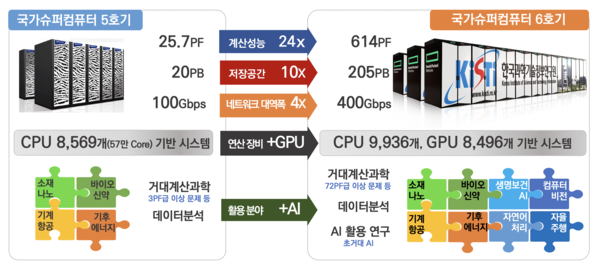
South Korea's sixth national supercomputer, Hangang, is set to enter full operation. Hangang has 24 times the computing performance of the existing fifth system and will be used as a core national infrastructure supporting large-scale science and technology research as well as AI-based research.
The Ministry of Science and ICT and the Korea Institute of Science and Technology Information (KISTI) held an inauguration ceremony for the sixth national supercomputer, Hangang, on Nov. 2 at KISTI's headquarters in Daejeon.
Hangang is a next-generation high-performance computing system that succeeds the fifth national supercomputer, Nurion, introduced in 2018. In addition to supporting computational science and simulation research based on existing central processing units (CPUs), it is also designed to support AI-based scientific research using graphics processing units (GPUs).
Hangang is equipped with Nvidia's CPU-GPU integrated accelerator chip, the GH200, along with 8,496 GPUs and 9,936 CPUs. Its theoretical computing performance is 614 PF, up 24 times from the fifth system. Storage capacity rises 10 times to 205 PB, and network performance increases fourfold to more than 400 Gbps.
It is expected to reach around the top 10 in the global Top500 supercomputer performance rankings, which will be announced at the International Conference for High Performance Computing, Networking, Storage and Analysis (SC2026) in early November. Nurion, which previously ranked 11th in the world, supported 1,730 research projects over the past eight years. This resulted in 1,520 SCI(E)-level papers, including 70 papers published in Nature, Science, Cell and their sister journals.
The ministry plans to use Hangang for national strategic research and development projects, including K-Moonshot, as well as for basic and challenging research by universities and government-funded research institutes and for companies' technology development. It has been recruiting researchers to use Hangang since September and is currently running a pilot service, with official service to begin on Dec. 14.
Kim Sung-soo (김성수), head of the R&D Policy Office at the Ministry of Science and ICT, said Hangang is a core foundation that will support the convergence of AI and science and technology to lead new scientific discoveries. He added it will actively support solving national challenges such as K-Moonshot and innovation research across industry, academia and research institutes.
Lee Sik (이식), president of KISTI, said it will do its best to ensure stable operations and user support based on its experience operating supercomputers.
 Jin-ho Lee
jhlee26@d-today.co.kr