
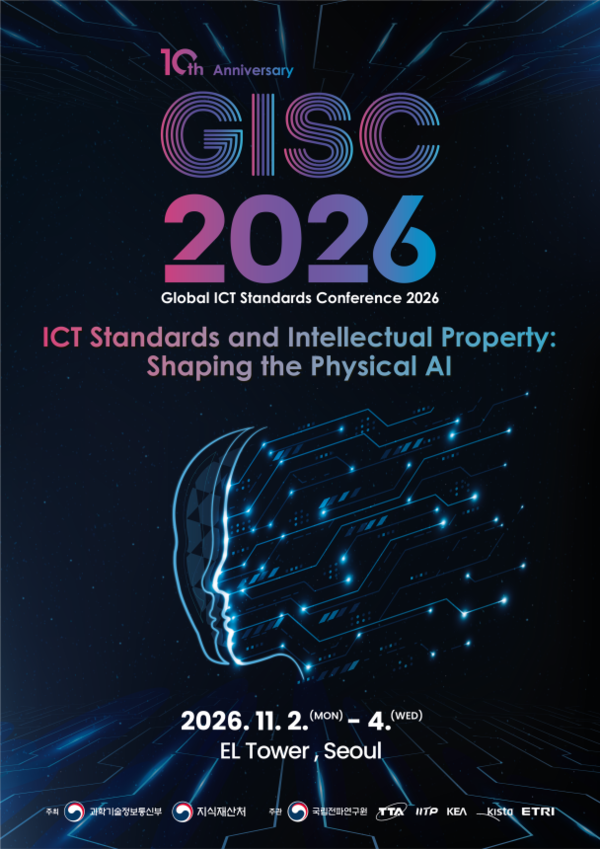
South Korea's Ministry of Science and ICT will jointly hold the 2026 Global ICT Standards Conference (GISC) with the Korean Intellectual Property Office through Nov. 4 at the EL Tower in Yangjae, Seoul, it said on Nov. 1.
Marking its 10th anniversary this year, the event will draw about 1,000 experts from South Korea and abroad to discuss standardisation directions and intellectual property strategies in ICT fields including AI, quantum and satellite communications.
The conference will focus on the importance of de facto standards led by private companies and institutions, as well as formal standards led by international standardisation bodies such as the ITU and ISO. It reflects a view that in fast-moving AI, de facto standards that can be quickly applied in the market are playing a larger role.
To that end, de facto standards bodies and organisations including MLCommons, IEEE, the European Telecommunications Standards Institute (ETSI) and Singapore's Infocomm Media Development Authority (IMDA) will take part to share global AI standardisation strategies.
The event will begin with a keynote speech by Young-jae Jang (장영재), a professor at KAIST, on autonomous manufacturing using manufacturing physical AI, cases of industrial-site application and the role of standards. A talk concert will then be held with domestic and overseas experts on the spread of AI and ICT standards and patents.
It will also present progress and future direction for the AI Partnership Project (AIPP), which is being pursued through cooperation among the Telecommunications Technology Association (TTA) and Europe's ETSI, as well as U.S. ATIS and Japan's TTC. A total of 27 citations and certificates will also be awarded to institutions and companies that have contributed to strengthening competitiveness in AI and ICT standards and patents.
The event will be split into a global track and a domestic track. The global track will cover standardisation strategies for AI, quantum and satellite communications and an AI transformation (AX) standards ecosystem involving companies, experts and de facto standardisation bodies. The domestic track will include an ICT standards and patent results presentation, a standards-essential patent seminar, a public hearing on a physical AI ICT convergence standards framework and a future innovation standards seminar.
Lee Do-gyu (이도규), head of the Information and Communications Policy Office at the ministry, said, "Along with technology development to lead global technological competition in the AI era, we will support expanding investment to preempt international standards and patents and fostering an open ecosystem."
Kim Il-gyu (김일규), director general for intellectual property policy at the Korean Intellectual Property Office, said, "We will strengthen related policies so that high-value standards-essential patents can be created from the R&D stage to secure global leadership in key future ICT areas such as next-generation communications and physical AI."
 Jin-ho Lee
jhlee26@d-today.co.kr