
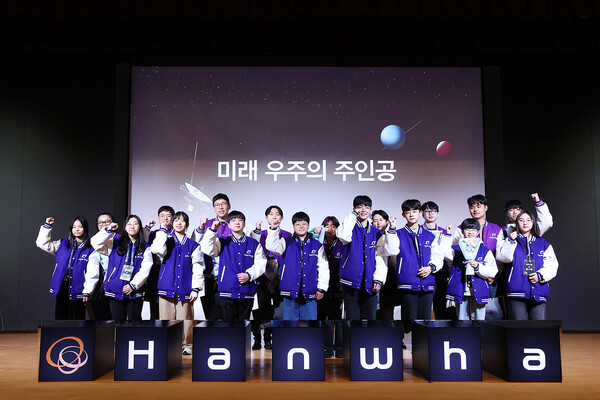
Hanwha said on Sunday that its space science talent development programme, "Space Pebble," hosted by the company and run by the Korea Advanced Institute of Science and Technology (KAIST), held a fourth cohort performance presentation and graduation ceremony on Jan. 10 at KAIST in Daejeon.
Attendees included graduates and their families, Son Jae-il, chief executive of Hanwha Aerospace, Park Jae-sung, head of the space transportation division at the Korea AeroSpace Administration, Kim Dae-gwan, head of the KPS Development Project Division at the Korea Aerospace Research Institute, Lee Jeong-ryul, head of KAIST's aerospace engineering department, and Han Jae-hong, head of the KAIST Space Institute.
Hanwha has continued to show its commitment to the space industry since launching "Space Hub," its integrated brand that brought together the capabilities of its space affiliates, in 2021.
A total of 30 fourth-cohort graduates, selected through a 48.5-to-1 competition, completed about six months of training starting in July. At the event, they carried out a space mission project under the theme "Exploration beyond the solar system," developing creative imagination into an engineering research process.
The presentation was organised into sessions that began with the question, "What if Earth is about to be destroyed?" It included a space telescope to search for a second Earth, a probe for interstellar navigation, the solar system's final space station, a nuclear fusion-based propulsion system, a deep-space navigation system and an amphibious lander design. The graduates ultimately showcased research results on exploring a second Earth, completed through six months of collaboration.
The 30 fourth-cohort graduates will receive certificates in the name of the KAIST president and follow-up training opportunities including a visit to the U.S. National Aeronautics and Space Administration (NASA) and courses at the KAIST Gifted Education Center. A venue is also set to be 마련ed to allow them to continue developing future career paths and interests in space through networking with existing graduates.
In a congratulatory address, Son said Hanwha will discover and foster students with potential and capabilities in the space sector over the long term. He said it will focus on investment that sows the seeds so South Korea can further develop independent space launch capabilities and leap into a space power.
 Daegeon Seok
d2dg@d-today.co.kr
Daegeon Seok
d2dg@d-today.co.kr