
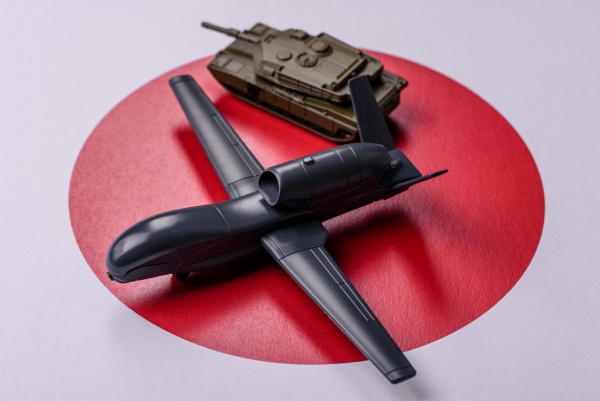
Japan is speeding up efforts to build a domestic production system to reduce reliance on a China-centred drone supply chain. It aims to secure competitiveness in unmanned systems by shifting private drone firms toward defence work and expanding government budgets.
Tech site TechRadar reported on Aug. 5 that Japanese Prime Minister Sanae Takaichi is pushing to expand domestic drone production and is reviewing steps to reduce a supply chain structure concentrated in Chinese companies.
Chinese companies account for about 90 percent of the global industrial drone market. The Japanese government has judged that such a structure could be a security vulnerability and has moved to secure a domestic production base.
Japan's ruling Liberal Democratic Party approved a plan on June 9 to build capacity to produce about 80,000 drones a year by 2030. Specific funding measures to support large-scale production have not yet been clearly presented.
In Japan's drone industry, Eams Robotics and Terra Drone are drawing attention as examples of a shift toward defence. Eams Robotics started in 2016 as a drone firm for broadcast filming and expanded into manufacturing from 2018. It has developed autonomous flight systems with Sagawa Express, the University of Tokyo and NTT Docomo. The company conducted a test in December 2025 in which it passed through a railway section in operation by fully autonomous flight without ground surveillance personnel. Possibilities of cooperation with U.S. defence startup Anduril Industries have also been mentioned recently.
Terra Drone is focusing on strengthening supply chains for batteries and defence drones. Batteries are known to account for more than 25 percent of drone manufacturing costs, but Japan lacks battery suppliers that meet defence-level requirements.
Terra Drone is pushing to mass-produce Japanese-made batteries, and CEO Toru Tokushige said Japan's Defence Ministry is showing strong interest in its business. He said demand for unmanned systems in Japan is growing as drones are used as key forces in the war in Ukraine.
Government investment is also expanding. Japan's budget related to unmanned defence systems has risen to 277 billion yen this year. That is more than double 111 billion yen in 2025. Japan's overall defence spending is also set to expand to about 3.5 percent of gross domestic product, raising the possibility of further increases in investment in unmanned forces including drones.
Japan's Acquisition, Technology and Logistics Agency under the Defence Ministry also plans a demonstration next month of interceptor drones to be deployed around radar bases and key facilities. It is a move to secure an ability to respond to long-range loitering munition drones. As threats grow from long-range loitering munition drones such as Iran-made Shahed-136 used in Middle East conflicts, Japan is preparing for new threats that are difficult to counter with existing missile defence systems alone.
The expansion of drone production is also linked to Japan's defence self-reliance strategy. As speculation emerges that delivery of Tomahawk missiles to Japan could be delayed amid concerns over missile stockpiles after a recent U.S. operation against Iran, Japan is further stressing the need to strengthen its own defence production base.
U.S. and Japanese authorities denied the possibility of supply disruptions, but Japan's defence minister said it would continue to pursue domestic missile development. Efforts to secure core weapon systems such as drones and missiles domestically are progressing at the same time.
There is also speculation about expanding production bases. Some have suggested that Anduril considered converting a car factory in Japan into a drone production facility to prepare for a possible rise in tensions in the Taiwan Strait. It was not confirmed whether it will be pursued.
Japan's drone expansion strategy is part of a five-year military buildup plan running through 2027. The plan also includes strengthening missile networks and developing unmanned ground and maritime systems. It remains a challenge whether the higher production target will translate into a real increase in military capability. Whether Japan can reduce dependence on China and secure stable supply chains and production capacity is seen as a key variable in future drone defence competition.
 Jinju Hong
hongjj@d-today.co.kr
Jinju Hong
hongjj@d-today.co.kr