
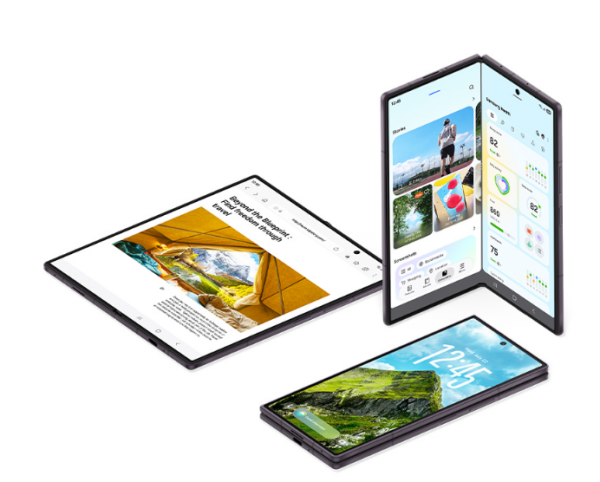
[DigitalToday reporter Jinju Hong] Samsung Electronics’ next foldable smartphone, the Galaxy Z Fold 8 Ultra, is drawing market attention with a thinner design and an improved screen crease compared with its predecessor. It focused on reducing thickness and the crease, long seen as chronic issues for foldable phones, by improving the hinge and display structure rather than simply changing the exterior.
Tech outlet TechRadar reported on Aug. 5 (local time) that the biggest change in the Galaxy Z Fold 8 Ultra lies in its internal structure rather than its appearance. The device keeps a form similar to a regular smartphone when folded and offers an 8.0-inch large display when unfolded. Samsung Electronics placed ultra-thin glass and flexible AMOLED beneath the screen protection layer and applied a new titanium panel structure.
The newly applied titanium panel consists of two types. One is a pure titanium panel with a perforated structure, and the other is a titanium alloy sheet that is thinner and stronger than the existing polymer sheet. This makes the screen and frame mesh more flatly when unfolded and noticeably reduces the crease in the center display compared with before.
Samsung Electronics reduced the body to about 4.1 mm, thinner than the previous model’s 4.2 mm. It also improved parts that some users said made the previous model difficult to unfold, aiming to achieve both a thinner profile and usability. The power button also changed from a recessed design so users can more easily locate it with their fingertips.
The camera setup keeps a total of five cameras. The 200-megapixel main camera remains the same, but the ultra-wide camera is upgraded sharply to 50 megapixels from 10 megapixels. Samsung Electronics also improved its image processing technology, the ProVisual Engine, focusing on color expression and detail correction. TechRadar assessed that hair rendering and background blur effects in portraits improved, and that night and macro shooting quality also got better.
The telephoto camera, however, keeps the same 3x optical zoom 10-megapixel sensor. The outlet said it was disappointing that longer optical zoom was not applied, and noted that reliance on digital correction could increase for zoom shots above 3x.
Performance is based on Qualcomm’s latest chipset. Samsung Electronics offers an AI experience combining Galaxy AI with Google Gemini and Bixby. Key functions include the photo editing tool Photo Assist and Now Brief, which organizes schedule and context information. If a user allows Gemini to access email and schedules, it automatically organizes the day’s schedule and the location of the next meeting. It can be launched by pressing and holding the power button, and a Pro version with some advanced features is provided for 6 months.
Multitasking features using the foldable large screen have also been strengthened. On the main screen, up to four apps can run simultaneously, and 8K video editing can be handled smoothly on the device. A dual-camera shooting mode and a My Fan Cam feature were also added. My Fan Cam lets users select a specific person in a video, after which AI automatically tracks the subject and reconstructs the video into an aspect ratio suited for social media.
Battery performance has also improved. Despite the thinner body, it includes a 5,000 mAh battery and applies a titanium alloy sheet and silicon-carbon battery technology. Suggested actual usage time is about 12.5 hours for mixed use in bright outdoor conditions and up to 14 hours in laboratory tests. It supports 45W wired fast charging and 20W wireless charging.
The price has risen from the previous model. The Galaxy Z Fold 8 Ultra starts at $2,099.99 in the United States, up $100 from its predecessor. The base Galaxy Z Fold 8 goes on sale starting at $1,899.99. It will be released in Graphite, Cream, Green Shadow and Violet Shadow.
Some shortcomings remain. The screen crease has been greatly reduced but has not completely disappeared. A slight ridge can still be felt when swiping a finger across the center of the screen. Also, as with the previous model, it does not include a digitizer layer to support the S Pen.
Even so, the market is assessing the Galaxy Z Fold 8 Ultra as a product that shifts the direction of foldable phones from a 'new form' to 'improving completeness'. TechRadar assessed that it achieved an inner screen close to virtually flat and the smallest screen crease to date, and said durability also improved enough for long-term use in typical environments.
Samsung Electronics’ strategy in this product is seen as focusing on improving real user experience, including hinge structure, screen durability and AI features, beyond competing for thin foldable phones. There is an assessment that Samsung’s next step toward mainstream adoption of foldables has begun in earnest.
 Jinju Hong
hongjj@d-today.co.kr
Jinju Hong
hongjj@d-today.co.kr