
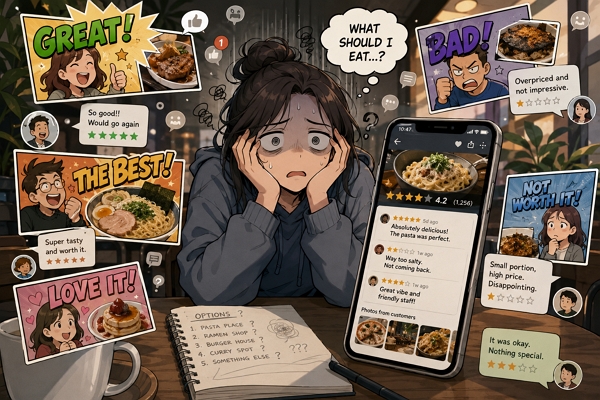
[DigitalToday reporter Choi Jae-won] Online reviews have emerged as a powerful tool to help consumers choose, but they have now reached a stage where they instead make choices harder, IT outlet Business Insider reported on Aug. 2. James Hardaway (제임스 하더웨이), who lives in Texas, is a "review-oriented consumer" who checks information carefully across various channels before buying something. Hardaway complained that while he saw it as "a necessary process to spend money properly," a stroller, dishwasher and mattress he bought based on reviews were not all satisfying. He said he ultimately reached a point where he kept doubting himself, saying, "I think there might have been a better choice."
This is also a broader picture of U.S. consumers. A 2016 Pew Research Center survey found that 8 in 10 Americans said they read online reviews before buying something for the first time. A 2026 Yelp survey also found that many Generation Z consumers look for information on at least 1 platform before choosing a restaurant, gym or hair salon.
Reviews are useful in that they move people away from an era of relying on brand advertising or a small number of expert assessments, and allow them to refer to real user experiences. The problem is that there are too many reviews and too many options. It is like spending 30 minutes scanning 15 restaurants and dozens of ratings to choose a pizza, and still being unable to decide. Barry Schwartz (배리 슈워츠), professor emeritus at Swarthmore College and author of The Paradox of Choise, said, "Once you start looking for the best, the road to unhappiness is straight." He explained that the price of having unlimited options is that even small decisions become more burdensome.
The structure of internet platforms also reinforces this tendency. Google shows star ratings before websites, and Amazon places reviews more prominently than prices. AI search engines are moving toward summarising online ratings before showing links. Consumers may feel they gain authority for their choices through others' evaluations, but in practice it is difficult to know who wrote the reviews and whether they match one's preferences.
AI is making review culture more complicated. Some platforms use AI to compress and summarise hundreds of reviews. This can help quickly gauge the overall tone, but it also risks missing individual tastes and context. For example, a consumer might rate a body wash poorly because they dislike the scent of cucumber, but an AI summary could convey it simply as "the scent is not good." It could also over-reflect a small number of negative opinions or include incorrect information.
The problem of fake reviews is also emerging. With AI tools, it becomes easier to mass-produce false reviews, and it becomes harder for consumers to tell the difference. An official at a fake-review monitoring group pointed out that "review manipulation has long been a huge problem, and some businesses trade reviews or secure reviews through intermediaries." The U.S. Federal Trade Commission in 2024 set rules banning false ratings and testimonial endorsements and imposing monetary penalties for violations, but the issue of platform responsibility still remains a limitation.
Experts advise that people should change how they use reviews rather than abandon them. Sheena Iyengar (시나 아이옌가), a professor at Columbia Business School, said, "Before looking at reviews, you need to set your own criteria first." If you vaguely look for the best bar or the best gym, you fall into endless comparisons, but setting specific conditions such as a quiet place with plenty of seating, or a place with enough weight equipment and classes, raises satisfaction, she said.
There is no need to optimise every choice. Most consumer decisions are minor choices that people do not even remember as time passes. People should spend time on important decisions, but need to leave everyday choices to a certain degree of autopilot. Just as the best stroller may not be the top product recommended by experts but the one that is actually used often, the key is that reviews should be closer to reference material than a correct answer.
 Choi Jae-won
ittt_0801@d-today.co.kr
Choi Jae-won
ittt_0801@d-today.co.kr