
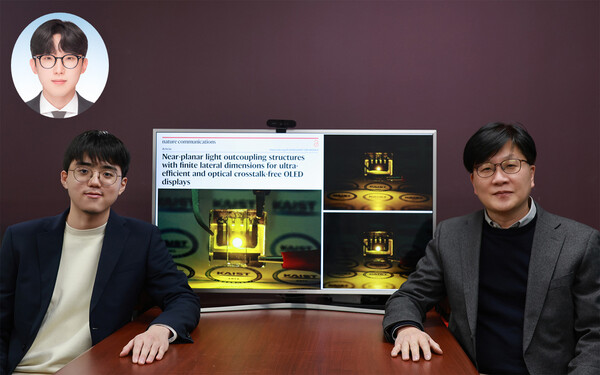
KAIST researchers have developed a semi-planar light extraction structure that improves OLED front light efficiency by 2 times. KAIST said on Saturday that a team led by Professor Seung Hyub Yoo of the School of Electrical Engineering developed a technology that boosts luminous efficiency by more than 2 times while maintaining the planar structure of OLED displays.
OLEDs are used in smartphones and TVs for strong color reproduction and a thin, flexible planar structure. But internal light loss has limited efforts to increase brightness. The team developed a new semi-planar light extraction structure and an OLED design method to overcome the limit.
OLEDs are made by stacking multiple layers of organic thin films. As light passes between layers, it is reflected or absorbed, and more than 80 percent of the light generated inside the OLED fails to exit and disappears as heat. This is a main factor limiting OLED luminous efficiency.
Previously, light extraction structures such as hemispherical lenses and micro lens arrays (MLA) were used to pull light out by attaching lens structures on top of OLEDs. But hemispherical lenses protrude with a large lens, making it difficult to maintain a flat form. Micro lens arrays must be much larger than pixel size to achieve sufficient extraction, limiting the ability to deliver large efficiency gains without interference with adjacent pixels.
The team proposed a new OLED design method to emit light as efficiently as possible within each pixel size. It explained that, unlike conventional designs that assume the OLED extends infinitely, the method considers the limited pixel size used in real displays.
This allowed more light to be emitted externally even in pixels of the same size. The team also developed a new semi-planar light extraction structure that helps light emerge toward the front of the screen without spreading sideways.
It can also be easily applied to flexible OLEDs. The team said it succeeded in improving light emission efficiency by more than 2 times in small pixels by applying the new OLED design and the semi-planar light extraction structure together.
The technology can produce a brighter screen with the same power while maintaining OLEDs' flat structure. It is expected to help extend battery life in mobile devices such as smartphones and tablet PCs, reduce heat generation, and improve display lifespan.
Professor Seung Hyub Yoo said, "Many light extraction structures have been proposed, but in many cases they were mostly for lighting with a large area, and it was difficult to apply them to displays made of numerous small pixels, or even when applied, the effect often was not large." He added, "The semi-planar light extraction structure presented this time was implemented to maximize efficiency while also reducing interference between light from adjacent pixels by imposing size constraints relative to the light source within a pixel."
The research was published online in the international journal Nature Communications on Dec. 29, 2025.
 Daegeon Seok
d2dg@d-today.co.kr
Daegeon Seok
d2dg@d-today.co.kr