
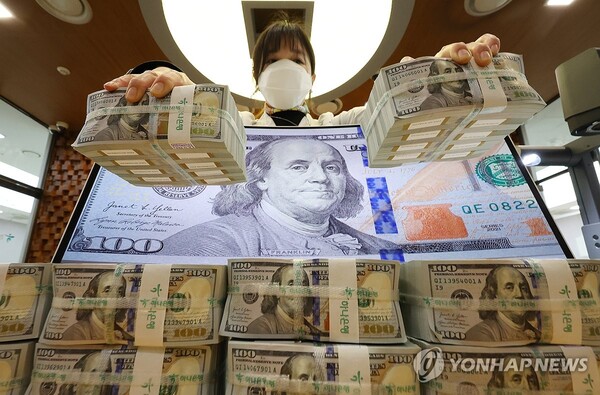
So far this year, South Korean retail investors' net buying of U.S. stocks has reached a record high for the period.
As a dollar supply-demand imbalance blamed for last year's weak won continues, the exchange rate has risen for seven consecutive sessions, giving back more than half of its year-end drop.
According to the Korea Securities Depository and the Bank of Korea on Jan. 11, domestic retail investors net bought a total of $1.942 billion worth of U.S. stocks through Jan. 9 this month, or about 2.84 trillion won.
It was the largest amount for the same period, Jan. 1 to 9, since records began in 2011. It was 43 percent higher than a year earlier, when net buying stood at $1.357 billion.
The number of trading days in the period was broadly similar, and was 6 days as in last year.
Retail buying of U.S. stocks strengthened in earnest from last autumn, then eased in December, but appears to be picking up again in the new year.
Retail investors' net buying of U.S. stocks surged from $3.184 billion in September last year to $6.855 billion in October, the largest on a monthly basis, and reached $5.934 billion in November.
It fell to $1.873 billion in December due to demand for profit-taking sales and efforts to reduce capital gains taxes.
The net buying amount in early 2026 is also larger than in early October last year, when it was $1.327 billion for Oct. 1 to 9.
On a daily average, it was about $277 million, slightly below the daily averages for the full months of October and November last year of $298 million and $296 million, respectively.
Although the government announced measures late last year including tax exemptions for retail investors returning to the domestic market, enthusiasm for investing in U.S. stocks does not appear to be easing easily.
With dollar demand continuing as a result, the exchange rate has risen every day since the start of the new year.
In the Seoul foreign exchange market on Jan. 9, the won's daytime trading close against the dollar, as of 3:30 p.m., was 1,457.6 won. That was up 27.8 won from Dec. 29, when it was 1,429.8 won.
The exchange rate had plunged 53.8 won over the previous 3 sessions due to factors including intervention by the foreign exchange authorities and the announcement of supply-demand measures. It has since risen little by little, reversing more than half of the drop.
It is on its longest rising streak since July 1 to 9 last year, when it rose for 7 consecutive sessions amid the impact of U.S. reciprocal tariffs.
When the exchange rate approached 1,500 won last month, authorities mobilised a range of policies, including strong verbal intervention, strategic currency hedging by the National Pension Service and tax exemptions for retail investors returning to domestic stocks, to lower the year-end close. The rate appears to be rising again as the structural dollar supply-demand imbalance has not been resolved.
Lee Nak-won, an FX derivatives specialist at NH Nonghyup Bank, said, "The recent rise in the exchange rate is largely driven by real demand." He said, "Dollar demand from individuals' net buying of overseas stocks and settlement demand from importing companies is flowing in continuously."
The won posted the biggest weakness among major currencies in the new year.
Yonhap Infomax said the won's value fell 1.34 percent against the dollar so far this month.
The won fell the most, along with the Canadian dollar. The Swiss franc fell 1.07 percent, and the euro fell 1.00 percent as price indexes in major countries including Germany and France came in below market expectations.
Experts say a high exchange rate of around 1,450 won is likely to persist for the time being unless structural factors driving the dollar supply-demand imbalance, such as the undervaluation of the domestic stock market and gaps between South Korea and the United States in interest rates and growth, are resolved.
Seo Jung-hoon, a senior researcher at Hana Bank, said, "Since it will take time for the won's underlying strength to improve fundamentally, there is a possibility that, in the meantime, authorities will continue to foster caution in the market and the exchange rate will likely remain supported around the 1,450 won range for some time."
The foreign exchange authorities have continuously signalled a willingness to stabilise the exchange rate, drawing attention to whether additional supply-demand measures will be announced.
Finance and Economy Minister Koo Yun-cheol said at a market situation review meeting on Jan. 8, "Since the current exchange rate is detached from fundamentals, it is important for policymakers to continue firm and consistent policy efforts." He added, "Follow-up measures should also be pushed forward swiftly."
[Yonhap News Agency]
 Online Team
d-today@d-today.co.kr
Online Team
d-today@d-today.co.kr