
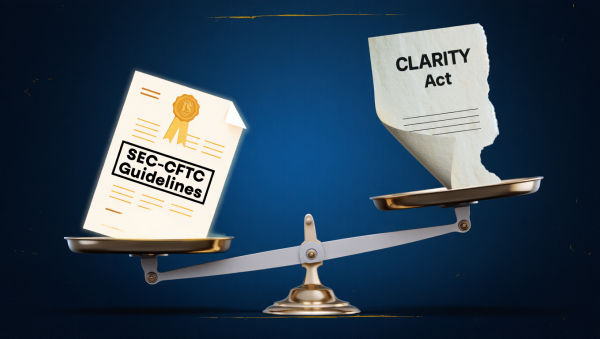
[DigitalToday reporter Jinju Hong (홍진주)] JPMorgan has assessed that uncertainty in the cryptocurrency market is growing as the likelihood of the Senate passing the U.S. crypto market structure bill known as the Clarity Act declines. The market is raising concerns that if the bill is delayed, expansion of institutional investment and the buildout of blockchain financial infrastructure could also be pushed back.
According to blockchain media outlet CoinPost on Thursday, JPMorgan analysts said in a recent report that the lower chance of the Clarity Act passing the Senate this year could act as a burden on the cryptocurrency market.
Prediction markets have also sharply cut the likelihood of passage. On Kalshi, the probability of approval this year fell to 37 percent. On Polymarket, it stood at 26 percent, the lowest level this year.
JPMorgan said the Senate is prioritising other legislative tasks ahead of the summer recess. It also said differences between the parties remain unresolved on key issues including ethics rules, the allocation of authority among regulators, stablecoin interest payments, decentralised finance (DeFi) and anti-money laundering (AML).
The Clarity Act is a market structure bill that clearly separates cryptocurrency oversight powers between the U.S. Commodity Futures Trading Commission (CFTC) and the U.S. Securities and Exchange Commission (SEC). It stipulates that the CFTC oversees digital commodities and the SEC oversees digital securities.
The bill passed the House of Representatives in July last year. In the Senate, processing has been delayed as debate continues over whether to allow stablecoin interest payments and whether politicians should be required to disclose cryptocurrency-related holdings.
JPMorgan forecast that if the bill passes, market infrastructure for institutional investors will be put in place and regulatory uncertainty over DeFi and stablecoin issuers will be largely resolved. It also said some trading could move from offshore markets into the U.S. regulatory framework, increasing domestic trading volume and liquidity, and boosting market entry by brokerages, exchanges, market makers, custodians and banking platforms.
It added that the current bill is not market-friendly in every respect. JPMorgan said some provisions could instead limit institutional investor participation.
It cited as issues a structure in which DeFi platforms can trade tokenised securities and tokenised derivatives without direct oversight by the SEC or CFTC, and that some crypto businesses perform functions similar to banks or brokerages without fully bearing anti-money laundering obligations.
JPMorgan also forecast that if the bill process is prolonged, the direction of growth for blockchain financial services itself could change. It said tokenised assets and blockchain-based financial services could be increasingly absorbed into existing financial infrastructure rather than public blockchains.
Calls to pass the bill are also continuing in the industry. Crypto industry group the Crypto Council for Innovation argued in a recent report that if the market structure bill is delayed, the United States could hand leadership in digital asset regulation and technological innovation to other countries and could, over the long term, negatively affect the dollar's status as the world's reserve currency.
Senate negotiations are currently in the final coordination stage. Republican Senator Thom Tillis and Democratic Senator Ruben Gallego submitted a new compromise related to ethics provisions to the White House on Wednesday.
Democrats are calling for stronger ethical standards, citing as cases of conflicts of interest a memecoin issued by President Donald Trump before taking office and World Liberty Financial, which they say is linked to the president's family.
The Senate is set to begin its summer recess on Aug. 7, but with Senate Majority Leader John Thune maintaining a stance of prioritising other bills, deliberations on the Clarity Act are increasingly likely to be pushed to after the September session.
 Jinju Hong (홍진주)
hongjj@d-today.co.kr
Jinju Hong (홍진주)
hongjj@d-today.co.kr