
The government will shift the existing regional research and development (R&D) system, centred on the central government and individual provinces and metropolitan cities, to a zone-based locally autonomous model. Regions will set their own growth strategies and priority technologies, and science and technology institutes and government-funded research institutes will support project implementation.
The Ministry of Science and ICT said on Wednesday it held a launch event for the '4 hubs, 3 special regions autonomous regional R&D programme' at the Korea Advanced Institute of Science and Technology (KAIST) and will begin pushing projects for seven zones in earnest.
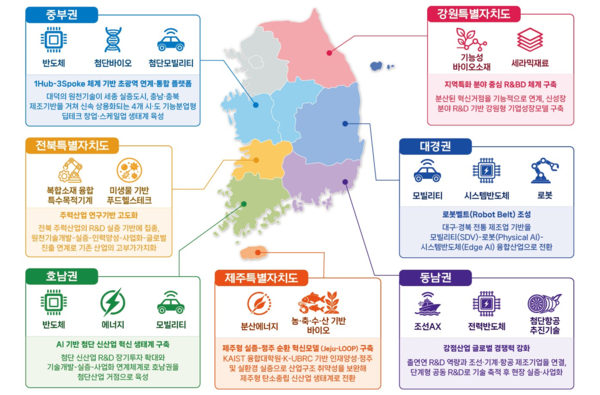
The four hubs are the central region, the Honam region, the Daegu-Gyeongbuk region and the southeast region, while the three special regions are Gangwon Special Self-Governing Province, Jeonbuk Special Self-Governing Province and Jeju Special Self-Governing Province. The ministry will invest a total of 78.9 billion won in the seven zones this year and will continue to expand support after 2027.
The programme is designed to move away from a system in which the central government planned individual tasks and allocated them to regions, with each zone analysing its industrial and science-and-technology capabilities and corporate demand to design the R&D it needs. The ministry, local governments, R&D support groups, science and technology institutes, government-funded research institutes, universities and companies drew up growth strategies by zone. The four hubs each selected 3 fields and the three special regions each selected 2, for a total of 18 priority technology fields.
The central region will invest a total of 13.1 billion won in semiconductors, advanced bio and advanced mobility. It will link Daejeon's fundamental R&D capabilities with Sejong's policy and demonstration role and the manufacturing and industrialisation strengths of South Chungcheong and North Chungcheong to build a deep-tech ecosystem spanning technology development, demonstration and commercialisation.
The Honam region will invest 13.1 billion won in semiconductors, energy and mobility. It will foster AI-based advanced industries by combining Gwangju's artificial intelligence (AI) and semiconductor design capabilities with South Jeolla's renewable energy and materials base. The Daegu-Gyeongbuk region will receive 13.1 billion won for mobility, robots and system semiconductors. It will use Daegu and North Gyeongsang's manufacturing base, including auto parts and electronic communications, to push the creation of a 'robot belt' linking software-defined vehicles (SDV), physical AI and edge AI.
The southeast region will invest 13.1 billion won in AI transformation (AX) for shipbuilding, power semiconductors and advanced aircraft propulsion technologies. It will link the shipbuilding, machinery and aviation manufacturing base of Busan, Ulsan and South Gyeongsang with the technological capabilities of research institutes to create a system that demonstrates technologies at manufacturing sites and commercialises them.
Gangwon Special Self-Governing Province will invest 8.8 billion won in functional bio materials and ceramic materials, and Jeonbuk Special Self-Governing Province will invest 8.8 billion won in special-purpose machinery and microorganism-based food and health tech. Jeju Special Self-Governing Province will invest 8.8 billion won in distributed energy and bio fields based on agriculture, livestock and fisheries, and will also push the establishment of a KAIST-Jeju National University fusion graduate school.
Science and technology institutes and government-funded research institutes will run the project groups for each zone. Each group will connect universities, companies and innovation institutions and oversee everything from project planning to task management and the spread of results. The government also plans to bundle research capabilities, industrial bases, demonstration environments and talent that are scattered across individual provinces and metropolitan cities into zone units to pursue large-scale and convergent R&D.
Koo Hyuk-chae (구혁채), first vice minister of the Ministry of Science and ICT, said, "This programme is the first to be 추진하는 project as zone-based, locally autonomous R&D." He added, "We will support a virtuous cycle to take root in regions, where research outcomes lead to company growth and good jobs, and new talent and investment in turn spur R&D."
 Jin-ho Lee
jhlee26@d-today.co.kr
Jin-ho Lee
jhlee26@d-today.co.kr