
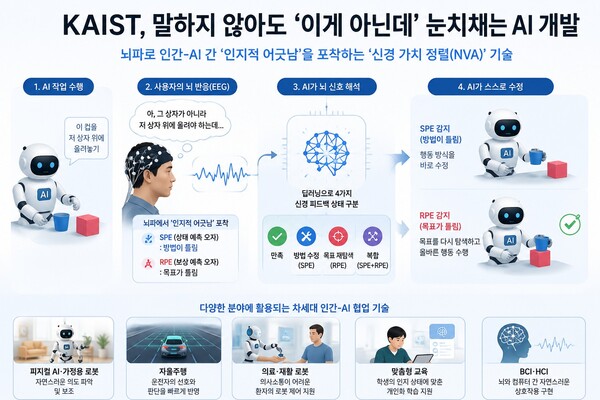
AI technology has been developed that can identify intentions through brainwaves and modify its own behaviour even when a person does not express intentions through words or actions.
The Korea Advanced Institute of Science and Technology (KAIST) said on Wednesday that a research team led by Sang Wan Lee (이상완), a chair professor in the Department of Brain and Cognitive Sciences, jointly developed a brain-computer interface (BCI) technique called Neural Value Alignment (NVA) with Microsoft Research Asia. The technique uses human brainwaves to align AI with a person’s goals in real time.
Existing AI mainly identifies intentions based on information that appears externally, such as a person’s words, actions or gestures. But the same action can have different purposes, limiting AI’s ability to accurately grasp a person’s actual intention.
The research team focused on the “prediction error” that occurs in the brain when a person encounters a situation different from what was expected. It also divided this prediction error into “reward prediction error” (RPE), which appears when AI misunderstands a person’s goal itself, and “state prediction error” (SPE), which occurs when the goal is correct but the process or method of action differs from what was expected.
After measuring real-time brainwaves (EEG) of people watching AI perform tasks, the team confirmed that different brainwave signals appeared when the goal was wrong and when the action method was wrong. It also identified a characteristic brainwave pattern that appears when the two errors occur at the same time.
Using deep learning, it developed a technique that distinguishes how a person perceives AI’s actions using brainwaves alone. This approach allows AI to determine from brainwaves whether its goal or its action method is wrong even if a person does not directly point out the error.
The team proposed a “Neural Value Alignment-based human-AI synergy” algorithm that delivers signals read from brainwaves to AI in real time to correct its behaviour. When SPE is detected, AI judges that the goal is correct but the action method is wrong and modifies its behaviour. When RPE is detected, it considers that it has misunderstood the goal itself and searches again for the goal the user wants.
Simulation results showed it adapted faster than existing methods to changes in intentions, even when a person’s goal suddenly changed or some signals were missing. The team expects the technology can later be used for physical AI robots to adjust actions after identifying a user’s intention, or for self-driving cars to reflect a driver’s judgement.
Sang Wan Lee said the study is significant because it shows AI can move beyond estimating human intentions from visible action outcomes alone and directly use cognitive signals in the brain that arise behind actions for collaboration with AI.
The study included doctoral student Seo Heun (서흔) of KAIST’s Department of Brain and Cognitive Sciences as first author. The findings were published online last month in the international journal IEEE Transactions on Cybernetics.
 Jin-ho Lee
jhlee26@d-today.co.kr
Jin-ho Lee
jhlee26@d-today.co.kr