
Google has been confirmed to have leaked to an external website information submitted by victims of digital sex crimes and support organisations seeking deletion of victim videos. The government is reviewing whether related laws were violated, saying legal responsibility could apply separately from Google's pledge to prevent a recurrence.
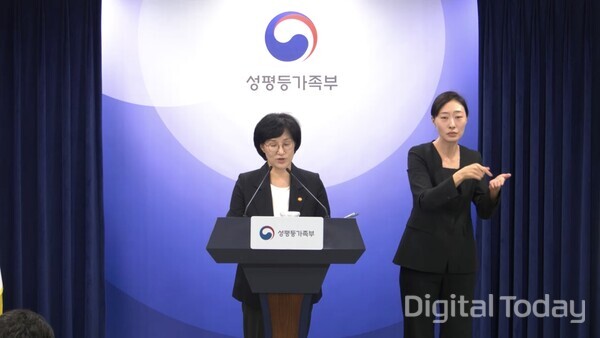
Wonn Min-kyung (원민경), minister of gender equality and family, said at a briefing at the Government Complex Seoul on Sept. 11 that the incident was not a matter that could be lightly dismissed as a simple system error or mistake. If illegal conduct is confirmed, Google must bear corresponding legal responsibility, she said.
The Ministry of Gender Equality and Family said it confirmed on Aug. 25 that during the process of requesting deletion of digital sex crime victim videos, some information submitted to Google by victims and support organisations was unlawfully disclosed on an external website.
The government said information in requests to delete victim videos, which victims and support organisations submit to Google, must not be shared externally. It determined that some request details passed through Google to the site. The ministry did not disclose the site's name, citing concerns including secondary harm.
Google has so far explained to the government that the incident occurred due to "technical and human errors". Google has said its basic policy is not to share externally information related to illegal filming content.
After first blocking information that could identify victims, the government expanded the scope of blocking in stages to include information searchable by related institution names.
Choi Eun-hee (최은희), director of the Digital Sex Crime Deliberation Bureau at the Korea Communications Standards Commission, said the commission received a request for an emergency review from the ministry on Aug. 26. She said it took emergency blocking measures on Aug. 28 for 15 of 18 reports at the individual post level, excluding two duplicates and one that was not being distributed.
As of Sept. 1, about 200 cases searchable by the names of victim support organisations, including the Korea Women's Human Rights Institute, were blocked. From the early hours of Sept. 7, the site was confirmed to have blocked the full set of deletion request details that individuals and support organisations in South Korea had submitted to Google.
The government identified about 20 cases of information that could enable victim identification. The ministry said duplicated URLs and other overlaps meant the count did not match the actual number of victims.
The ministry held an emergency meeting with Google on Sept. 5 and expressed strong regret over the circumstances of the leak and delays in action. It resumed support for deleting victim videos from Google on Sept. 9 after receiving an official letter of commitment from Google pledging not to share with the external site information related to deletion requests received in South Korea in the future.
The government said it will not consider the matter closed based on the pledge.
Wonn said the government believes Google's legal responsibility can be established regardless of the pledge. She said if such an incident happens again despite the commitment, even heavier responsibility would be imposed.
Kim Sung-cheol (김성철), director general for safety and human rights policy at the ministry, said in cases involving illegal sexual exploitation materials, punishment could apply if they fall under third-party provision under the Act on Special Cases Concerning the Punishment of Sexual Crimes, the Act on Promotion of Information and Communications Network Utilization and Information Protection, and the Personal Information Protection Act.
The Korea Communications Commission is also closely reviewing whether there were violations of the Telecommunications Business Act and the Act on Promotion of Information and Communications Network Utilization and Information Protection.
Shin Young-gyu (신영규), director general of the broadcasting and communications users policy bureau at the Korea Communications Commission, said authorities are also investigating other platforms besides Google. He said they are examining how they have provided information to the external site, their deletion methods and user protection measures.
The government plans to look not only at the cases confirmed this time but also at the possibility of additional leaks in the past. It also plans to consult relevant ministries on a plan to directly inspect whether systems were actually improved based on recurrence prevention measures that Google will submit.
Wonn said the foundation of recurrence prevention measures is to accurately determine how the incident occurred. She said she will thoroughly check to the end whether Google's recurrence prevention measures are prepared effectively and carried out in practice.
 Son Seul-gi
sageson@d-today.co.kr
Son Seul-gi
sageson@d-today.co.kr