
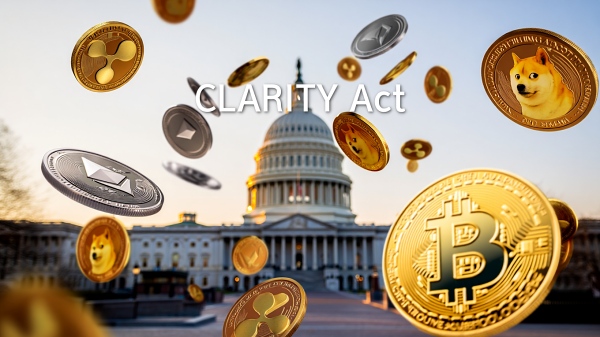
Bipartisan U.S. senators have crafted a new compromise on ethics provisions in the Clarity Act, a cryptocurrency market-structure bill, but it remains unclear whether the legislation will be taken up before the August recess.
CoinPost, a blockchain outlet, cited foreign media outlets including The Block and CoinDesk as saying on July 31 that Republican Senator Thom Tillis and Democratic Senator Ruben Gallego delivered a compromise on the Clarity Act’s ethics provisions to the White House.
The Clarity Act is a sweeping market-structure bill that divides regulatory authority over cryptocurrencies between the U.S. Securities and Exchange Commission and the Commodity Futures Trading Commission. The bill passed the Senate Banking Committee in May. The specific language of the compromise has not been disclosed, but it was reported to narrow differences between Democrats and Republicans over provisions limiting the involvement of senior government officials in cryptocurrency businesses.
At the center of the dispute is the conflict-of-interest issue involving U.S. President Donald Trump. Democrats have called for stronger ethics rules, citing a memecoin Trump introduced before taking office and World Liberty Financial (WLFI), in which the Trump family was involved. Asset disclosure documents released last month also showed that Trump received millions of dollars through cryptocurrency businesses.
A previously released revised draft was approved by Trump. It barred public officials and their spouses from issuing and backing cryptocurrencies, but did not apply to other family members. It granted enforcement authority to the U.S. Department of Justice and was designed to automatically expire in January 2029. Officials pointed out that the sunset clause could effectively nullify the entire ethics framework. Democrats see the White House-approved ethics rules alone as insufficient to address the president’s cryptocurrency business-related issues.
The timeline for passing the bill is also tight. The Senate is set to go into recess from Aug. 7, but no unanimous consent agreement or cloture motion has been filed so far to bring it to the floor. Senate Majority Leader John Thune said in a Fox News interview on July 28 that government agency budgets and personnel measures were top priorities, while leaving open the possibility of handling the Clarity Act through procedural votes. Thune, however, has maintained his earlier view that the bill is unlikely to reach final passage.
Pressure from the market and industry is also continuing. Democrats are not changing their opposition stance until ethics rules strong enough to prevent conflicts of interest are in place. Within the Republican Party, disagreements have emerged over an interest compensation system for stablecoin users. The banking industry is pushing back, saying such a system could trigger outflows of bank deposits.
Treasury Secretary Scott Bessent has argued on social media that Democrats are responsible for the bill not yet reaching a vote. On the same day, the crypto industry group Crypto Council for Innovation warned that other regions such as the European Union are moving ahead with regulatory preparations, and that the United States could lose its lead in market regulation if it fails to pass the bill.
With Senate leaders prioritising other legislation, it is increasingly likely that consideration of the Clarity Act could be pushed back until after Congress reconvenes in September. Even if a compromise is reached on ethics provisions, it was forecast that the bill’s passage could again be delayed unless it clears two hurdles: securing 60 votes and being scheduled for floor consideration.
 Yoonseo Lee
yslee@d-today.co.kr
Yoonseo Lee
yslee@d-today.co.kr