
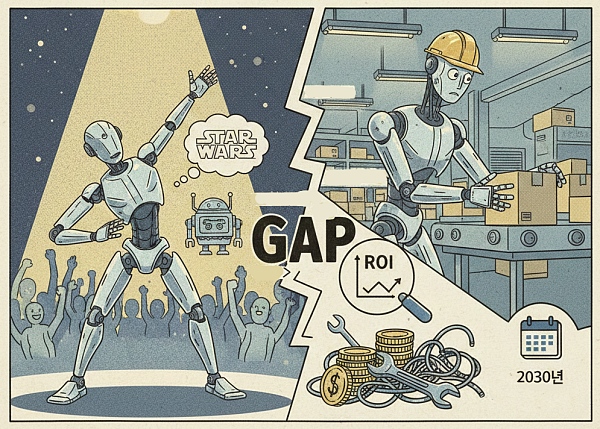
Humanoid robots appeared in force at CES 2026, showing that generative AI technology is beginning to change the robotics industry in earnest, CNBC reported on Jan. 9 local time.
Nvidia announced a new vision-language model, Gr00t, and unveiled technology that lets robots use sensor input to control their bodies. As expectations grow that AI-based robots will transform industry, the sector is calling it the "ChatGPT moment" for AI robots.
AMD and Qualcomm, as well as Nvidia, announced new robotics technologies at CES, intensifying competition in AI-based robots. AMD worked with Italian company Generative Bionics to unveil an industrial robot, Gene.01. Qualcomm announced a robot-specific chip, Dragonwing, and declared an expansion of the AI robot ecosystem.
Hyundai Motor unveiled Atlas, a humanoid robot under development through Boston Dynamics, at CES 2026. It set a goal of producing 30,000 robots a year by 2028. It plans to deploy Atlas in its own car factories to support assembly work. The strategy is to develop technology so robots can perform complex assembly beyond simple repetitive tasks.
Above all, the AI robot industry is advancing rapidly by combining with generative AI technology. The humanoid robots shown at CES 2026 strongly suggested that AI-based robots will become central to future industry, regardless of commercial success. In this regard, market research firm McKinsey forecast the humanoid robot market will reach $370 billion by 2040 and said key applications include warehouse logistics, light manufacturing, retail operations, agriculture and healthcare.
Still, despite flashy humanoid robot demonstrations, experts said at least 5 years more are needed before commercial use. It remains uncertain how quickly robots shown at CES will be adopted in real industrial sites.
Taiwan's DigiTimes called 2026 an inflection point for humanoid robot commercialization but cited return on investment as the core reason for slow adoption. It said Tesla's humanoid robot Optimus target price of under $20,000 is only possible if mass production is in place, and that current prototypes and early mass-produced models are too costly for small and medium-sized companies or ordinary households.
Use cases are also limited. U.S. Robotics Business Review said early demand is likely to be confined to large companies' own factories and logistics warehouses, including those of Hyundai Motor, Tesla and Amazon.
Battery life and sophisticated object manipulation remain limited, and assessments say it will take time for the robots to spread into general service industries or home use. It also said that advances in large language models and vision-language-action models have made robots' "brains" smarter, but the maturity of embodied intelligence that turns that into real movement has not fully reached commercialization standards.
Millimetre-level precision work required at manufacturing sites and the ability to respond to unstructured environments are also still in the validation stage. Another obstacle is that international safety standards and insurance systems for robots operating in the same space as humans are insufficient. U.S. robotics technology company Standard Bots also said regulation and safety issues are major factors blocking large-scale deployment.
 Hyunwoo Chu
cookinpapa@d-today.co.kr
Hyunwoo Chu
cookinpapa@d-today.co.kr