
The South Korean government is launching research and development (R&D) to respond quickly to national emergencies such as cyberattacks, personal data leaks, new infectious diseases and chemical leaks.
The Ministry of Science and ICT said on Wednesday it selected 4 R&D projects for this year under the cross-ministry rapid-response R&D programme and has begun full-scale work.
The programme provides immediate budget support for urgent R&D demand that is hard to address in advance through regular budget planning procedures. It aims to rapidly develop technology needed when abrupt global technology changes or accidents that threaten public safety occur.
Existing national R&D programmes operate based on budgets allocated the previous year after advance planning, making it difficult to respond immediately to unpredictable emergencies. The science ministry collected R&D demand from central administrative agencies and evaluated the need and urgency of proposals. It selected 4 projects in cybersecurity, personal data protection, emerging infectious diseases and chemical accident prevention.
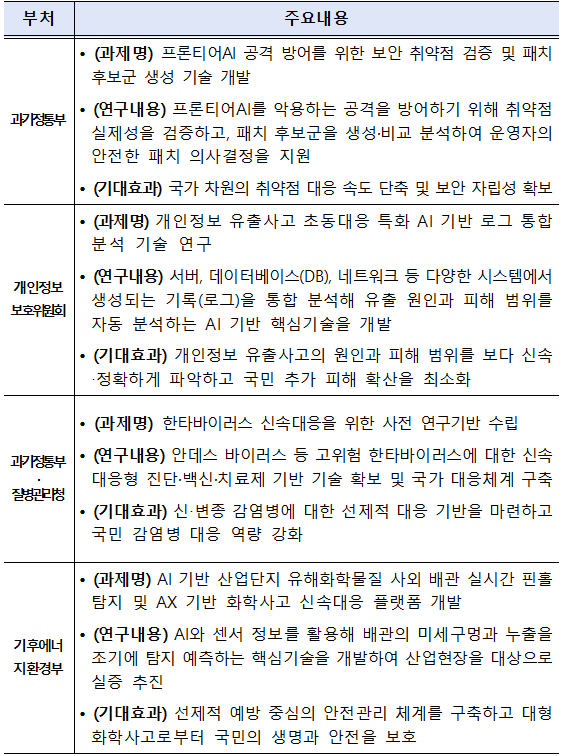
The science ministry will develop technology to verify and respond to security vulnerabilities to counter more advanced cyberattacks since the emergence of frontier AI models in April. It plans to secure technology that analyses increasingly intelligent attacks using AI and quickly finds and addresses vulnerabilities.
The Personal Information Protection Commission will develop initial response technology to quickly analyse the cause and scope of damage when large-scale personal data breaches occur. It aims to shorten early-stage analysis time to minimise the spread of further damage.
The science ministry and the Korea Disease Control and Prevention Agency will develop AI-based technology to discover vaccine and treatment candidates and rapid diagnostics in response to overseas cluster infections of the Andes variant hantavirus in May. They plan to use it to shorten development time for treatments and diagnostic technologies if new or variant infectious diseases occur in the future.
The Ministry of Climate, Energy and Environment will develop chemical accident prediction technology using sensors and information technology and pursue on-site demonstration, prompted by a series of chemical leaks including an outside-pipeline accident at the Ulsan industrial complex in April.
The science ministry said it plans to continue identifying and supporting additional projects, starting with this first selection, when national emergencies arise or relevant ministries raise R&D demand.
Park In-gyu (박인규), head of the Science and Technology Innovation Office at the Ministry of Science and ICT, said, "For unpredictable national issues, rapid technological responses are important." He added, "Through cross-ministry cooperation, we will strengthen the rapid-response R&D system and develop and apply, in a timely manner, the technologies needed at the policy front line."
 Jin-ho Lee
jhlee26@d-today.co.kr
Jin-ho Lee
jhlee26@d-today.co.kr