
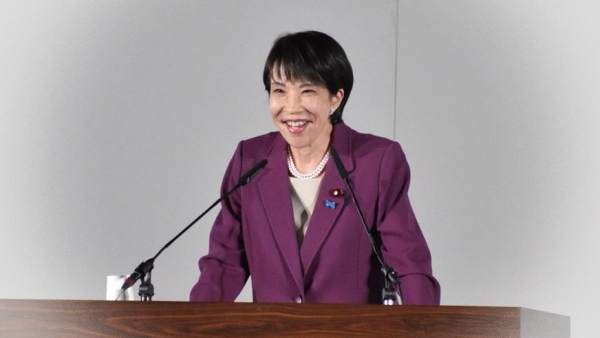
[Digital Today reporter Jinju Hong] Japan's Prime Minister Sanae Takaichi (다카이치 사나에) again said she did not approve or take part in a recently launched cryptocurrency named after her, "Sanae Token."
U.Today, a blockchain media outlet, reported on July 27 local time that Takaichi attended a meeting of Japan's House of Representatives and drew a line by saying she did not know the token existed.
The issue is not simply that a token bearing the name of a famous politician has emerged. Tokens using the names of celebrities are not rare because anyone can easily create cryptocurrencies, but this case spread into a political controversy after a link was raised to Tsuyoshi Kinoshita (기노시타 쓰요시), Takaichi's chief press secretary.
Sanae Token was reported to have been developed by people linked to businessman Ken Matsui (켄 마쓰이). Kinoshita acknowledged that he had indeed contacted business operators tied to Matsui. He said, however, that he believed what he understood to be involved meant app points, not an actual cryptocurrency. The key question is whether someone on the prime minister's staff made contact while aware the project was a cryptocurrency.
In an answer to parliament, Takaichi said she did not know the token existed. Kinoshita also acknowledged communicating with Matsui-linked operators, but said he understood it as app points rather than a cryptocurrency. The remarks denied a direct link between the prime minister's side and the project while leaving the need for further verification of the secretary's level of awareness.
The controversy also intersects with the Japanese government's friendly Web3 policy stance. Takaichi has generally supported efforts to foster Japan's Web3 and blockchain industry. The current conservative government has also pursued policies to promote tokenisation and related cryptocurrency businesses. The government, meanwhile, is also strengthening safeguards against fraud and unauthorised token issuance.
In this situation, the actual launch of a token bearing a politician's name and the emergence of indications of contact by a close aide to the prime minister align with Japan's task of improving its system. Even if it pushes market development and investment activation, how it responds to projects fronted by celebrities and disputes over unauthorised issuance could be directly tied to regulatory credibility.
Japan is also continuing discussions on bringing the sector into the institutional mainstream. Japan's finance minister, Satsuki Katayama (사쓰키 가타야마), has recently said Japan is pursuing procedures to approve cryptocurrency exchange-traded funds in line with the United States. There is talk that Japan could approve its first bitcoin fund by 2028. That leaves the Japanese government facing a situation in which it must handle three pillars at once: fostering the industry, institutionalising investment products and controlling illegal and unauthorised issuance.
Meanwhile, the direct point at issue is not the Sanae Token itself but the scope of involvement by the prime minister's staff. Since Takaichi has denied any connection, attention is expected to shift to what kind of business Kinoshita communicated with and whether the project leveraged political trust.
 Jinju Hong
hongjj@d-today.co.kr
Jinju Hong
hongjj@d-today.co.kr