
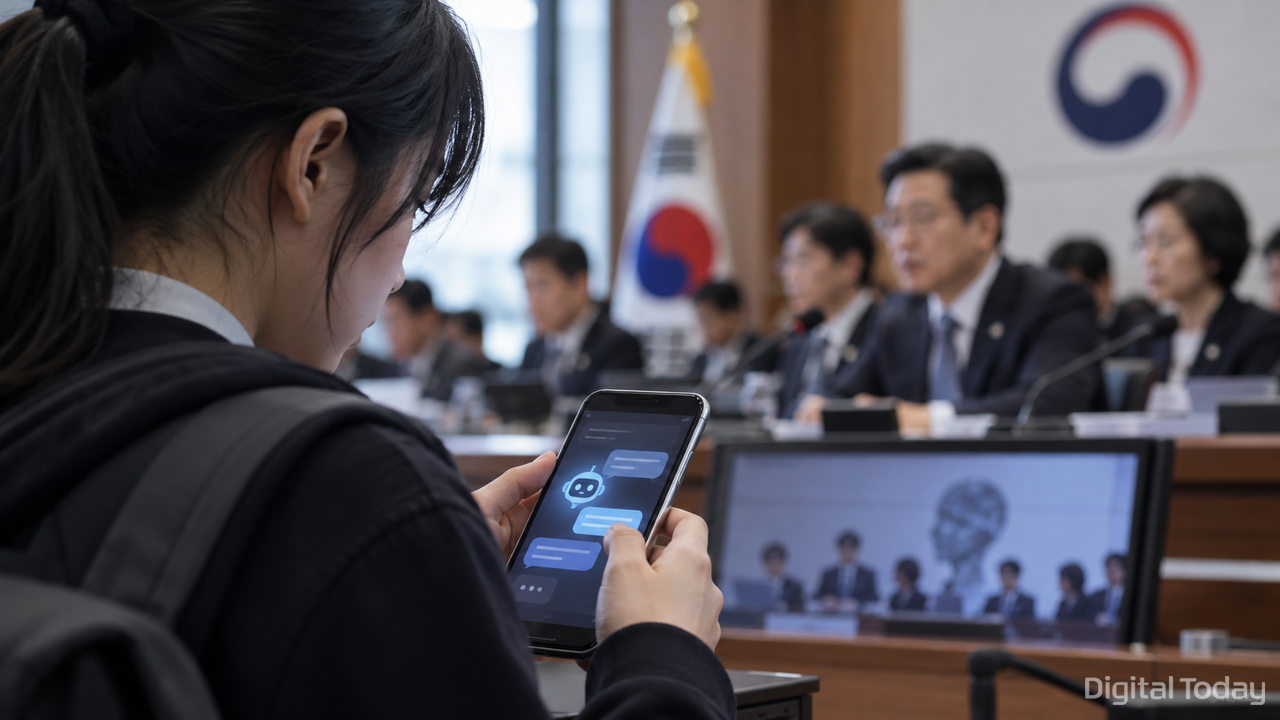
As concerns have been repeatedly raised over minors being exposed to harmful information and becoming overly immersed in AI chatbots, the government is moving to strengthen protective measures. It is pushing to supplement relevant laws and systems, including the Information and Communications Network Act and the AI Basic Act, and is also moving to enact a separate law to protect AI service users.
According to relevant authorities on the 27th, the Korea Communications Media Commission is preparing to enact a law tentatively titled the AI Service User Protection Act. It is a separate law aimed at preventing user harm arising from AI services and establishing a rights relief framework.
A draft released in the government's work report in December last year included an obligation for AI operators to prevent the creation and distribution of illegal information. It also included measures to prevent the creation of harmful information for minors under 19 and to prevent inducement of excessive immersion. The draft also covered special provisions for relational AI services, guarantees of user rights and the introduction of a dispute mediation system.
The commission in May launched a second phase of its public-private consultative body on AI service user protection and is discussing measures to improve related systems. In August it discussed technical safety measures to respond to illegal and harmful information in AI services and plans for industry self-regulation.
A commission official said the bill is being prepared without major changes in direction from the draft released last year. The official said the commission plans to reflect, to the extent possible, measures discussed in the consultative body for AI operators to protect children and adolescents and views from a range of stakeholders including industry, academia and the legal sector. The official added that the legislative timetable is flexible depending on the approach and circumstances, including whether it proceeds as a member-sponsored bill.
The Korea Communications Media Review Commission will begin full-scale reviews of AI chat services in November. The reviews will apply existing laws and rules, including the Youth Protection Act, the Information and Communications Network Act and the Regulations on Deliberation of Information and Communications.
Ahead of the reviews, the review commission on the 21st held a cooperation meeting with 15 domestic and foreign AI chat service operators and shared cases including sexually suggestive character information and the generation of sexual conversations. It asked operators to strengthen functions to block illegal and harmful information at AI input and output stages and to restrict minors' access to adult content.
The review commission says it can also review character information and AI-generated information such as images and text provided by AI chat services. If an AI chat service is determined to be harmful media for youths, operators will be obliged under relevant laws to provide harmful-for-youth labels, conduct age and identity verification, and restrict minors' access. If illegal information such as obscene content or child and youth sexual exploitation material is found, it can also request corrective action such as deletion separately from any determination as harmful media for youths.
A review commission official said it will conduct reviews after comprehensively examining the sexual suggestiveness of character information and AI-generated information provided in AI chat services, as well as service operating structures. The official said separate policy support and supplementation of related laws and systems appear necessary for the problems of excessive immersion and overdependence among minors, apart from the commission's content reviews of AI chat services.
SCIENCE MINISTRY BACKS AI BASIC ACT REVISION; PARLIAMENT ALSO MOVES TO TOUGHEN PROTECTION DUTIES
The Ministry of Science and ICT, the lead ministry for the AI Basic Act, is supporting system improvement work for revising the law.
In March it launched a research group on improving the AI Basic Act system, involving experts from industry, academia and civil society, and has continued discussions so far. It plans to disclose concrete directions for revisions through a public hearing at year-end.
A ministry official said it discussed nearly all issues raised in connection with the AI Basic Act but it is currently difficult to confirm whether the issue of youth protection was addressed specifically. The official said it is still hard to say what will ultimately be reflected because multiple stakeholders, including civil society as well as academia and industry, are discussing the revision bill together.
Bills to strengthen AI operators' duties to protect minors have also been proposed in the National Assembly. Proposed amendments to the Information and Communications Network Act include a bill introduced in March by Lee Joo-hee (이주희), a Democratic Party lawmaker, to ban the creation and provision of youth-harmful information in AI services and to strengthen protective measures for relational AI, and a bill by Cho In-cheol (조인철) of the Democratic Party to mandate age verification and guardian consent. Lee also introduced an additional amendment this month to mandate functions to notify and limit AI chatbot usage time.
Proposed amendments to the AI Basic Act include a bill introduced in January by Jung Choon-saeng (정춘생) of the Rebuilding Korea Party to mandate technical protective measures such as suicide and self-harm prevention and blocking harmful content in AI services for minors, and a bill introduced in June by Cho to include children and adolescents among vulnerable groups for AI and to strengthen national-level protection measures. Both bills are under review in the National Assembly's science and ICT committee.
Still, as revisions to the AI Basic Act and the Information and Communications Network Act and the enactment of a separate user protection law are being pursued simultaneously, there is criticism that discussions are also needed on regulatory scope and how to protect the rights and interests of children and adolescents.
Choi Kyung-jin (최경진), a professor in the law department at Gachon University, said the best interests of children and adolescents should be considered first, including whether it is desirable to unconditionally restrict use for youth protection or whether guaranteeing free choice is better. Choi said that because blocking harmful information is an issue already handled within the existing legal framework, there is a need to overhaul the system in consideration of AI's characteristics of creating and spreading it more quickly.
 Seul-gi Son
sageson@d-today.co.kr