
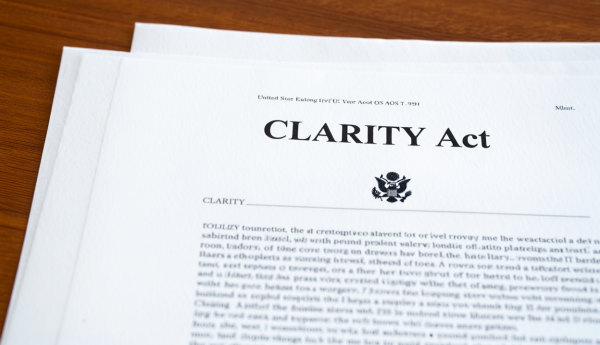
The U.S. Senate's CLARITY crypto market-structure bill has run into fresh obstacles as Democrats and Republicans clash again over ethics provisions. Republicans tried to compromise with a revision, but key Democrats are still opposed, making passage before the August recess uncertain.
On July 23, blockchain outlet CryptoSlate reported that the White House pushed back after Democrats rejected the latest revision. But opposition within the Democratic Party continues, making it difficult to secure the votes needed for a Senate ballot.
A revised proposal released by Republicans on July 22 includes ethics provisions that would bar senior officials, including the president and vice president, members of Congress and federal judges, from receiving compensation while in office and issuing or sponsoring digital assets. It would require crypto holdings above a certain size to be sold or placed in a blind trust not controlled by the official. It also includes a disclosure requirement for crypto sales exceeding $1,000.
The revision also includes a provision allowing the Department of Justice to exercise civil enforcement authority against exchanges that knowingly list prohibited digital assets.
Democrats said the measures are still inadequate. Seven Democratic senators — Angela Alsobrooks (안젤라 알소브룩스), Cory Booker (코리 부커), Catherine Cortez Masto (캐서린 코르테즈 마스토), Ruben Gallego (루벤 가예고), John Hickenlooper (존 히켄루퍼), Mark Warner (마크 워너) and Raphael Warnock (라파엘 워녹) — said ethics rules and safeguards against illicit finance and conflicts of interest are not sufficient.
Elizabeth Warren (엘리자베스 워런), the top Democrat on the Senate Banking Committee, criticised the revision, saying it would not meaningfully restrict President Donald Trump's existing crypto business. "It does not stop Trump from earning additional profits from his crypto business," she said.
Amanda Fischer (어맨다 피셔) of financial policy think tank Better Markets also pointed to transaction fees or reserve-asset management income from existing Trump-related businesses as not clearly covered by regulation. She also said enforcement could be weakened because the Justice Department would have to prove "knowing and intentional" violations to pursue civil penalties.
The White House, by contrast, said differences have narrowed significantly. Patrick Witt (패트릭 위트), the White House's senior adviser on cryptocurrency, said the key remaining issues are whether to give state attorneys general authority to enforce the ethics provisions and whether to include Trump's past crypto business in the scope of regulation. In a post on X, formerly Twitter, he said not granting separate enforcement authority to state attorneys general is consistent with the existing federal ethics law framework, pushing back against the Democratic stance.
The vote count is also challenging. Republicans hold 53 Senate seats, but to clear the 60 votes needed for a procedural ballot they would need at least seven Democrats to vote in favour. Unity within the Republican Party is also not complete, with Senator Thom Tillis calling for stronger ethics provisions and Senator John Kennedy voicing concerns about stablecoin compensation provisions.
The industry has also raised concerns that the dispute over ethics provisions could derail the entire bill. Miles Jennings (마일스 제닝스), head of crypto legal policy at venture capital firm Andreessen Horowitz (a16z), warned that if talks collapse, regulatory work across the digital asset market — including rules for exchanges and brokerages and anti-money laundering frameworks — could also be delayed.
Coinbase's head of policy, Faryar Shirzad (파르야르 시르자드), said, "Major legislation requires compromise," adding the industry also did not get everything it wanted. Ripple's chief legal officer Stuart Alderoty (스튜어트 알데로티) also cited anti-money laundering and consumer protection provisions and urged swift action on the bill, saying, "Perfection must not stand in the way of a better outcome."
Democratic negotiators said opposing the current revision does not mean opposing the bill itself. They said that once a regulatory framework is set, it is difficult to revise later, making it necessary to strengthen ethics provisions at this stage. Talks are continuing with the goal of passing the CLARITY bill before the August recess, but the partisan tug-of-war over ethics provisions is expected to continue for some time.
 Jinju Hong
hongjj@d-today.co.kr
Jinju Hong
hongjj@d-today.co.kr