
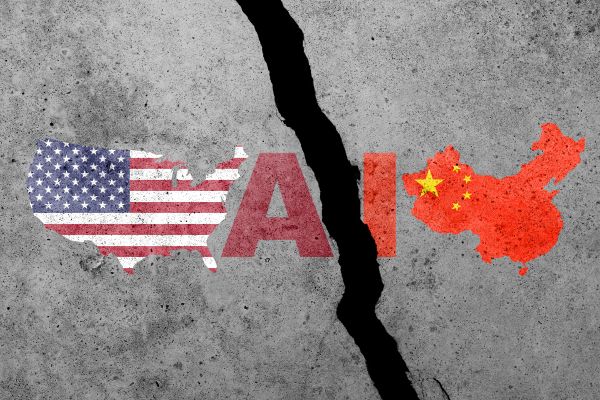
The U.S. government is investigating whether Chinese open-source artificial intelligence (AI) models infringed intellectual property and warned it could impose sanctions on Chinese AI companies if violations are confirmed. The move raises the possibility that U.S. pressure on China over AI could expand beyond advanced semiconductors and export controls to development methods and intellectual property issues.
Major foreign media outlets including TechCrunch reported on July 21 local time that U.S. Treasury Secretary Scott Bessent (스콧 베센트) said in an interview with Fox Business that he would review whether Chinese AI models used U.S. companies' intellectual property without authorisation.
Bessent drew a line by saying the U.S. government is not opposed to open-source AI itself. He said there is much discussion about open-source models that threaten U.S. large language models (LLMs), adding, "We support open-source models, but we do not support intellectual property infringement."
He added that if indications are confirmed that foreign AI companies stole U.S. companies' technology, the U.S. government has the authority to impose sanctions based on such theft.
The comments came as the performance of Chinese AI models and the speed of their global spread are rising rapidly. A recent example frequently cited is "Kimi K3" disclosed by China's Moonshot AI. Concern is growing in the United States that Chinese open-source models could disrupt the business models of leading domestic companies such as OpenAI and Anthropic and could even weaken their ability to raise funds for next-generation AI development.
Reports have also said the Trump administration is reviewing a plan to completely ban the use of Chinese open-source AI models in the United States. There are differing views on whether it will be pursued, but Bessent's remarks show U.S. regulation could shift from AI chips and data centre equipment to the models themselves.
U.S. AI companies have repeatedly warned that foreign firms could use their models' outputs and technology to develop similar models and then distribute them as open-source. The White House also said in April it would work with U.S. AI companies to respond to such technology theft.
The central issue is "model distillation". Model distillation is a technique that transfers the performance and knowledge of a large AI model to a smaller, lighter model. It is widely used in AI development, but the industry is divided over whether distillation that uses a competitor model's outputs constitutes intellectual property infringement.
Microsoft Chief Executive Officer Satya Nadella (사티아 나델라) publicly questioned this logic earlier this month. He pointed to what he described as a contradiction in allowing training on public data under fair use principles while seeking to apply separate restrictions to distillation that uses trained models.
U.S. AI companies are also not free from issues over training data and copyright. Anthropic recently became able to begin procedures to pay compensation to authors under a $1.5 billion settlement. A court found that Anthropic illegally downloaded and stored millions of copyrighted books for AI training.
A counterargument has also emerged against the claim that Chinese AI firms' catch-up was possible solely through model distillation. Hugging Face CEO Clem Delangue (클렘 들랑그) said in a recent podcast that distillation is only part of the process of developing high-performance AI models and is a technique used by most AI companies, including U.S. firms.
He said that if superior models could be easily made through distillation alone, many more high-performance open-source models would already have emerged in and outside the United States. He added that China has many excellent AI researchers and assessed that a more open and collaborative approach to research than U.S. companies also underpins its competitiveness.
If the U.S. government moves ahead with sanction procedures, U.S.-China AI competition is expected to expand beyond semiconductor supply chains and export controls into disputes over model training methods and intellectual property. How the United States distinguishes technology theft from legal model distillation is expected to emerge as a key issue.
 Jinju Hong
hongjj@d-today.co.kr
Jinju Hong
hongjj@d-today.co.kr