
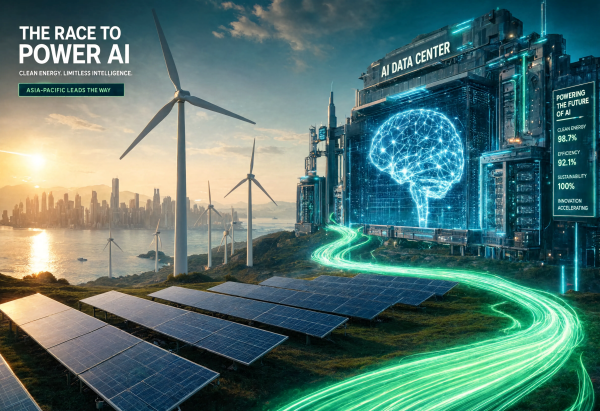
[DigitalToday reporter Jinju Hong] The Asian Development Bank (ADB) is pushing a plan to invest $50 billion by 2035 in building a pan-Asian power grid to respond to electricity demand driven by the spread of artificial intelligence (AI). Adding $20 billion in funding to build digital infrastructure, it presented energy and communications infrastructure projects worth a total of $70 billion.
Cleantechnica, an electric-vehicle specialist outlet, reported on July 20 local time that ADB unveiled a plan to build a pan-Asian power grid that would connect fragmented national power systems and enable cross-border trading of renewable energy.
Rapid expansion of AI data centres, semiconductor plants and digital industries underpins the view that national grids alone will struggle to meet surging demand. Large-scale AI computing facilities and advanced semiconductor plants, in particular, consume enormous electricity and require stable power supplies.
Masato Kanda (마사토 칸다), ADB president, said at the annual board meeting in Samarkand, Uzbekistan, that energy and digital access will determine the future of Asia-Pacific. He said linking power grids and digital networks across borders can cut costs and expand growth opportunities.
The pan-Asian power grid is a large infrastructure project spanning Southeast Asia, South Asia, Central Asia, West Asia and the Pacific. It will expand on the existing ASEAN Power Grid, South Asia Subregional Economic Cooperation and the Central Asia Regional Economic Cooperation (CAREC) energy strategy, with investments including cross-border transmission lines and substations, battery energy storage systems (BESS) and digital grid technologies.
ADB plans to raise about half of the total project cost from its own resources, with the rest secured through governments, development partners and private investors. The bank forecast the project could enable integration of about 20 gigawatts of renewable energy and construction of 22,000 circuit-kilometres of transmission lines by 2035. It also estimated it could improve electricity access for 200 million people, cut carbon emissions in the power sector by 15 percent and create about 840,000 jobs.
ADB will also invest $20 billion to build an Asia-Pacific digital superhighway. It will expand fibre-optic networks, subsea cables, satellite communications and regional data centres, and will also pursue stronger cybersecurity and AI capabilities.
The Seoul AI Innovation and Development Center, supported by South Korea with $20 million, is set to provide AI and digital technology training to about 3 million people by 2035. The digital superhighway project aims to add 200 million new high-speed internet users and improve connection quality for an additional 450 million people.
The plan also aligns with a trend of expanding hyperscale data centre investment across Asia. In Singapore, Malaysia, Indonesia, Thailand and the Philippines, global big tech companies continue to invest in data centres, and the 'Pax Silica' economic security corridor in New Clark City in the Philippines is also being developed as a hub for AI and semiconductor industries.
The need for grid integration is growing in markets and in policymaking. At the Asia Clean Energy Forum held in Manila last month, governments, power companies and regulators shared the view that power demand from AI, electric vehicles and industrial electrification is difficult to meet with national grids alone, and discussed the need to expand regional grid connections.
But there is also significant opposition. Climate and civil society groups raised concerns, saying building large-scale power grids alone does not guarantee a just energy transition. They said measures are needed over the sustainability of continued fossil fuel investment, environmental damage during critical minerals development and infringements on Indigenous rights.
Ultimately, the initiative shows that competitiveness in the AI era depends not only on computing capacity but also on how much stable, affordable power can be secured. Competition in AI industries across Asia is expected to be decided not only by data centres but also by the speed of building energy infrastructure that links power grids across countries.
 Jinju Hong
hongjj@d-today.co.kr
Jinju Hong
hongjj@d-today.co.kr