
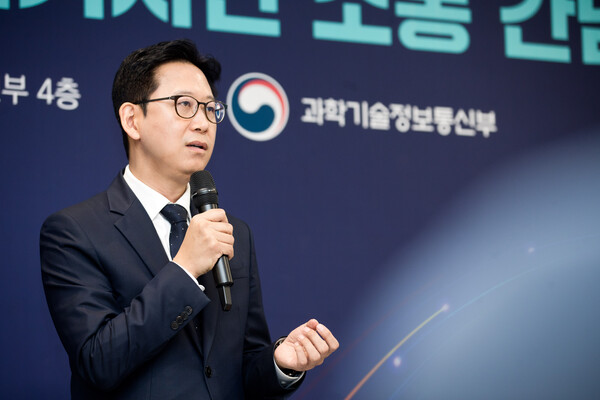
Deputy Prime Minister and Minister of Science and ICT Baek Kyung-hoon (배경훈) assessed the past year since taking office as a period of building a foundation for an AI transition. He said he will deliver tangible results in frontier models, agentic AI and physical AI. He also plans to speed up the rollout of "AI for Everyone" and step up efforts to build a Korean-style AI ecosystem.
Baek said at a first-anniversary news briefing at the Government Complex Sejong on Sunday that a basic foundation had been laid to build a science and technology society in the AI era. "Now is the time to create tangible results on that foundation and prove them," he said.
He cited as the most meaningful achievements over the past year the homegrown AI foundation model project and the building of a social consensus on the need to secure graphics processing units at the national level. He explained that, unlike the past, awareness has spread across society that the country must have its own AI capabilities. "I thought a lot about how to build fundamental competitiveness in AI services," Baek said. "It is important to make those preparations without a hitch," he added.
He pointed to as a task the fact that AI policy discussions have focused too heavily on a competition over model performance. "It is not only important to make AI models," Baek said. "To prepare for the agentic AI era, we must quickly build platform and token optimisation and real service competitiveness," he added.
Two-track strategy for homegrown AI and frontier models focuses on strengthening capabilities
The government is pursuing a "two-track" strategy to separately foster a homegrown AI foundation model that will be used mainly in industrial and public settings and a frontier model at the world’s top level.
The homegrown AI foundation model project focuses on securing models that can support the spread of public services and industry’s AI transition. Separately, it plans to be recognised as a country with world-leading AI competitiveness by investing in the development of top-tier frontier models such as Anthropic’s "Claude Mythos".
Baek said the government is continuing cross-ministry consultations because developing frontier-grade models requires much larger resource investment than before.
Baek said companies supported under the homegrown AI foundation model project are receiving 500 to about 700 Nvidia B200 GPUs. He said that to build a Mythos-class model would require about 10,000 Vera Rubin GPUs, with the purchase cost alone at about 3.5 trillion won at current prices.
With additional costs such as building platforms and clusters also requiring enormous sums, the ministry plans to consult the fiscal authorities and relevant ministries to prepare the budget, he said.
Baek also stressed that frontier models should be viewed as national strategic assets. "In the future, frontier-grade AI models will increasingly be something that countries try to control, almost like nuclear weapons," he said. "Because overseas AI services could be halted or prices could rise 20-fold or 100-fold, we must develop our own AI capabilities," he added.
The nationwide AI service "AI for Everyone," scheduled to be launched within this year, is expected to be a starting point for securing the competitiveness of domestic AI services. The ministry plans to provide public AI agents and specialised AI services in sequence after launching a general-purpose AI chatbot service for all citizens. "I do not expect people who are already paying to use overseas AI to immediately switch to AI for Everyone," Baek said. "It will have to provide better functions than existing services," he added.
In physical AI, the top priority will be building a system to secure data. The ministry will draw on competitiveness in manufacturing and semiconductors and build large-scale demonstration infrastructure to focus on producing real and synthetic data. "Within 1 year we must build a data-securement system, and within 3 years we must produce results such as a world model and a physical AI foundation model," Baek said.
AI infrastructure expands to 6G, national strategic technologies to be pursued through K-Moonshot
The government will also speed up work on building sixth-generation mobile communications, or 6G, a core infrastructure for the AI era. "In the agentic AI era, AI will produce and consume more tokens, and at the foundation communication infrastructure must be well built," Baek said. "We are continuously discussing this with the three telecom companies to lead 6G," he added.
In science and technology, the government will flesh out the "K-Moonshot" project centred on national strategic technologies. Project directors in each field will set challenging missions and goals, then prepare implementation plans and required budgets based on on-site demand and expert opinions.
"Rather than setting the policy direction in advance and then listening to expert opinions, we will sufficiently gather on-site demand and expert opinions from the start," Baek said. "As PDs specify plans and implementation plans and budgets are derived, we will announce policies in stages," he added.
The government will also innovate the research and development system. It will expand investment-type R&D that uses equity investment and project funding, as well as the existing approach of providing funds to companies.
Park In-kyu (박인규), head of the Science and Technology Innovation Office who attended the meeting, said the government will broaden investment-type R&D with the will to take responsibility for investments and participate in the process of creating results.
AI data centre power supply diversification, independent low-orbit satellite communications network by 2035
The ministry will also speed up the development of small modular reactor technology. The government expects demand for AI data centre infrastructure to keep increasing and is reviewing various power-supply options, including expanding nuclear power and renewable energy.
"We have not yet agreed with the Ministry of Climate and Energy, but I think we should leave open the possibility of LNG and also prepare a dedicated tariff system for AI data centres," Baek said. "The Ministry of Science and ICT, the Ministry of Climate and Energy and Korea Hydro & Nuclear Power are discussing an SMR-securement strategy," he added.
In space, the government will strengthen both satellite and launch-vehicle capabilities, targeting the commercialisation of low-orbit satellite communications in 2035. It plans to raise the number of launches and payload capacity for launch vehicles so that many satellites can be launched, as well as satellite technology competitiveness. The Korea AeroSpace Administration plans for the time being to focus policy capacity on lunar exploration and to 추진 stepwise exploration missions performing different tasks from 2029 to 2032.
The meeting also disclosed the status of an investigation into a Tving personal information leak incident. A public-private joint investigation team is closely examining the circumstances of the incident, the scale of the leak and the information security management system. Choi Woo-hyuk (최우혁), director general for the Information Security and Network Policy Office, said a detailed investigation is under way and that the team is preparing to finish it as quickly as possible and announce results in August.
Baek said that in his second year in office he will continue to innovate how the ministry works along with delivering policy results. "To build an organisation that communicates horizontally and can generate creative ideas, I will run things more strongly over the next year," he said. "I will do my part to ensure preparations for the great AI transition and a science and technology-based society lead to results," he added.
 Jin-ho Lee
jhlee26@d-today.co.kr
Jin-ho Lee
jhlee26@d-today.co.kr