
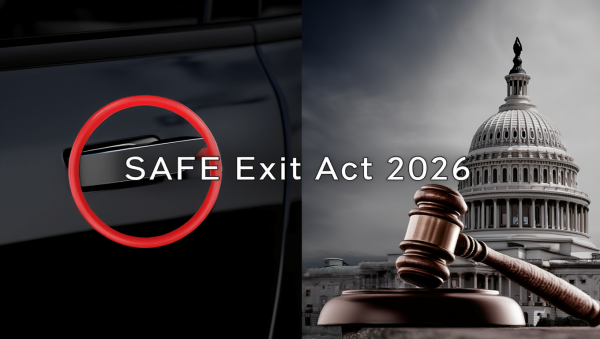
As safety concerns over electronic door handles on electric vehicles continue to intensify, the U.S. House of Representatives has introduced a bill that directly targets the issue. The bill is drawing industry attention as it effectively makes Tesla and CEO Elon Musk key targets.
On Jan. 8 (local time), U.S. Representative Robin Kelly of Illinois introduced the "Securing an Accessible, Functional Emergency Exit Act" (SAFE Exit Act), according to EV outlet Electrek. The bill would require a manual opening device that occupants can easily find and use even when a vehicle’s power is fully cut.
It is the first time a bill has been introduced to mandate a specific method for opening and closing vehicle doors. If it passes, automakers using electronic door handles, including Tesla, would need to apply new door handles with manual opening capability to new vehicles.
Across the auto industry, led by Tesla, the adoption of electronic door latches is spreading in place of mechanical door handles. The system uses a button or sensor to send an electrical signal to open the door, offering advantages such as greater design flexibility and improved aerodynamic efficiency. But safety concerns have repeatedly been raised that if a serious crash causes a loss of power, doors could remain locked if the manual override is not clear.
Most vehicles with electronic doors do have a manual release function, but it is often not intuitively located or is hard to access. Pointing to these issues, Kelly called for the National Highway Traffic Safety Administration (NHTSA) to establish performance standards and labeling requirements for electronic doors. The bill also includes provisions requiring clear manual-release instructions on each door and requiring a device that allows rescuers to access a vehicle from outside when power is cut. The bill has backing from Consumer Reports, which has long advocated intuitive manual opening devices.
Kelly, who introduced the bill, criticised Tesla and Musk in strong terms by name. For the Tesla Model 3 and Model Y in particular, the front seats have a relatively intuitive manual release device, but the manual release method for rear doors has been cited as hard for users to recognise.
The U.S. legislative move comes after similar EV safety regulations were recently formalised in China. Tesla is known to be preparing measures in response to the regulatory changes in China, and if the bill passes it could also significantly affect vehicle design in the United States.
In the industry, there is an assessment that, separate from controversy over rhetorical expressions, the purpose of strengthening escape safety in emergencies is valid. Experts have stressed the need for the bill, saying it is regulation focused on preventing accidents that could occur when occupants cannot find a manual release device while trapped in a vehicle.
 Jinju Hong
hongjj@d-today.co.kr
Jinju Hong
hongjj@d-today.co.kr