
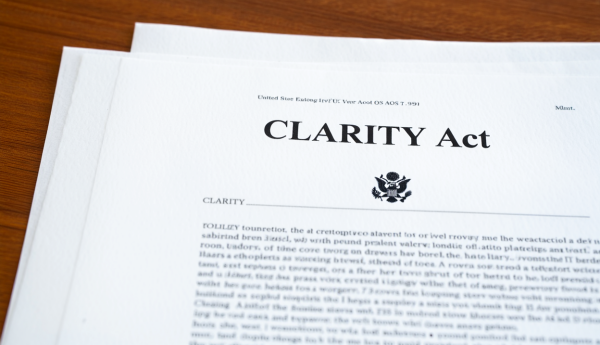
[DigitalToday reporter Yoonseo Lee] JPMorgan publicly backed the United States' federal digital asset bill known as the Clarity Act. It also warned that a weak regulatory framework could revive vulnerabilities that existing financial regulation was meant to block.
On June 29 local time, blockchain outlet Bitcoin Magazine reported that JPMorgan issued the position as the Senate pushes progress on the Clarity Act ahead of its August recess.
The position was set out in a joint article by Umar Farooq (우마르 파루크), global co-head of JPMorgan Payments, and Peter Muriungi (피터 무리운기), chief executive officer of digital assets and blockchain solutions. They said the United States has an opportunity to secure leadership in digital finance, but that regulatory clarity must come with sustainable safeguards.
"Regulatory clarity matters only when paired with strong safeguards," they said. "Clarity with loopholes or exceptions can push activity into weakly supervised channels and weaken long-standing protections," they added.
JPMorgan focused on the risk of regulatory gaps rather than the technology's advantages. It said an asset's economic character does not change simply because it is issued on a blockchain. Assets that look and function like securities should be subject to disclosure, custody and market integrity rules, it said. It added that decentralised trading platforms should be held to the same standards if they function like brokers or exchanges.
On stablecoins, it cited both business opportunities and competitive threats. JPMorgan said stablecoins and tokenised deposits could support faster payments and reduce friction costs in cross-border remittances. It warned, however, that payments innovation could effectively become shadow banking if such products offer yield-like incentives or allow balances to be held without bank-level capital, liquidity and consumer protection standards.
It also raised the risk of consumers being misled. JPMorgan said features such as rewards or cashback could lead many consumers to believe the product has familiar protections, and that if protections are absent the risk of large-scale withdrawals during a crisis could increase. JPMorgan CEO Jamie Dimon (제이미 다이먼) said last month, "Banks will not accept stablecoin yield provisions," and said the bank would respond through the final stages of bill discussions.
It also called for stronger anti-money laundering (AML) measures and law enforcement tools. It said broad exceptions for infrastructure that handles core transactions could create opaque mechanisms that conceal beneficial ownership structures, posing risks to both national security and market integrity. In Senate talks, contested issues still include stablecoin yield provisions, ethics rules for public officials with cryptocurrency interests, and the scope of liability protections for DeFi developers.
JPMorgan's stance also ties to an expansion of its own business. JPMorgan said on the same day that it increased the number of supported currencies on its blockchain payments platform Kinexys to 8. It added the Australian dollar, Hong Kong dollar, Japanese yen, Chinese yuan and Singapore dollar to the existing U.S. dollar, euro and British pound. The platform's cumulative processed transaction volume has exceeded $4 trillion, and its average daily volume is more than $7 billion.
Against that backdrop, U.S. congressional debate over legislating the Clarity Act is entering a phase where the interests of banks and the cryptocurrency industry directly collide. What compromise the Senate puts forward before the August recess is expected to be a key variable for the direction of U.S. digital asset regulation.
JUST IN: JPMorgan on the Clarity Act: "The United States must take great care in how it establishes a framework for digital assets." "The promise is clear." pic.twitter.com/gqVse4GKFy
 Yoonseo Lee
yslee@d-today.co.kr
Yoonseo Lee
yslee@d-today.co.kr