
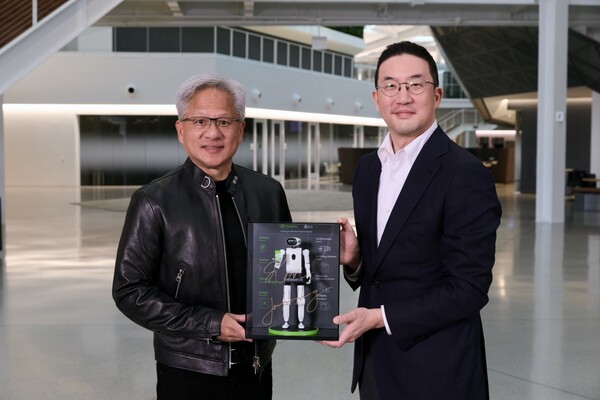
LG will equip its humanoid robot development with Nvidia’s artificial intelligence technology. LG and Nvidia said on Aug. 14 they will develop a next-generation bipedal humanoid robot using Isaac GR00T, an open humanoid-based model designed to move by judging situations like a person.
The robot will be unveiled in the first quarter of next year. The two companies signed a memorandum of understanding on Aug. 13 local time at Nvidia headquarters in Santa Clara, California. Nvidia founder and CEO Jensen Huang (젠슨 황) and LG head Koo Kwang-mo (구광모) attended the signing. Under the agreement, the companies plan to move their robotics, AI factory and mobility cooperation from the planning stage to execution.
The humanoid will carry Nvidia’s Jetson Thor, which processes computations directly on the robot body. Isaac GR00T and Halos for Robotics, a full-stack integrated safety system for robotics, will also be applied. LG will develop it under a “One LG” approach that combines actuator, sensor and battery capabilities held by LG Electronics, LG Innotek and LG Energy Solution.
The wheeled base robot LG CLOi will be deployed within this year on the washing machine production line at an LG Electronics plant in Tennessee in the United States. It is a procedure to verify performance in a real production environment. LG will reflect the demonstration results to improve the robot’s performance and usability. It plans to expand the scope of deployment to global production facilities, homes and commercial spaces.
◆Building an 80 MW AI factory in Cheonan in the first half of 2028
The cooperation also includes building a robot data factory based on LG CNS’s robot data platform PhysicalWorks. PhysicalWorks will be developed to continuously collect data needed for robot training in the field and to support synthetic data generation, training and verification. The two companies will also run a joint task force to handle research and development, on-site demonstrations and commercialisation together.
Robot data accumulated there and manufacturing-site demonstration experience will be used to strengthen the competitiveness of LG’s robot foundation model (RFM) under in-house development. LG will enhance its in-house AI model capabilities while using Isaac GR00T to raise its robotics technology competitiveness. AI factory cooperation will start with building a reference site in the first half of 2027 based on Nvidia’s Vera Rubin.
Based on these results, LG will build an 80 MW AI factory in Cheonan, South Chungcheong Province, by the first half of 2028. The facility will be used for physical AI, particularly to advance robot foundation models. LG will combine its thermal management, power, design and operations capabilities with Nvidia’s DSX architecture to verify an end-to-end solution. It then aims to supply a turnkey “One LG” package solution to global big tech customers.
In mobility, the companies will develop a next-generation, AI-defined, in-vehicle high-performance computing platform based on Nvidia Drive Hyperion. LG’s in-vehicle infotainment and automotive software capabilities will be integrated into it. LG plans to provide global automakers with a solution that bundles autonomous driving functions and in-car AI services.
Koo said, “As our cooperation gains speed, our shared goals in AI factories and physical AI have become clear. We will accelerate AI adoption by building an industry-leading reference.”
Huang said, “Building on years of collaboration, LG and Nvidia are combining LG’s leadership in product engineering and manufacturing with Nvidia technology to bring forward a new era of robots, AI factories and autonomous vehicles.”
 Daegeon Seok
d2dg@d-today.co.kr
Daegeon Seok
d2dg@d-today.co.kr