
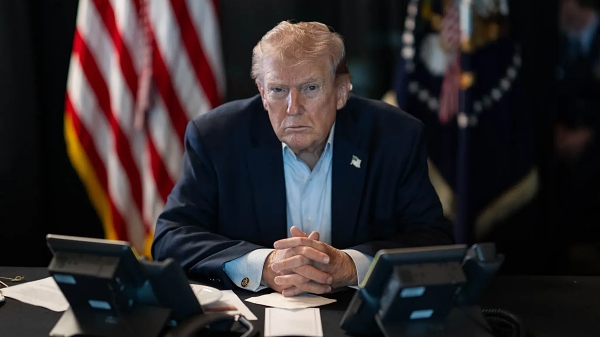
[Digital Today reporter Jinju Hong] U.S. President Donald Trump said he will impose 100 percent tariffs on large drones and related parts and apply 25 percent tariffs to other drones. The measures also target existing drone imports and parts entering the United States, and could directly affect the overall U.S. drone supply chain.
On Aug. 14 local time, major foreign media including tech outlet The Verge reported the targets include drones equipped with thermal imaging cameras, drones weighing more than 25 kg, and all types of parts used in unmanned aircraft over 25 kg. These will face a 100 percent tariff. Other drones, including "mini" consumer drones under 250 grams, will be subject to a 25 percent tariff.
The policy includes exceptions. Companies will not have to pay tariffs if they pledge to produce some drones or aircraft parts in the United States. Trump said the measures allow the commerce secretary to create a new program to spur investment in U.S. production facilities for unmanned aircraft and unmanned aircraft parts. The proclamation includes language approving a "program to encourage new investment in production facilities in the United States."
It also includes differentiated application by country. The European Union, Japan, Liechtenstein, South Korea, Switzerland and Taiwan will receive a lower rate of 15 percent. Britain will face 10 percent. The condition is that "substantially all" hardware, software and technology must come from the relevant country and the United States.
The move extends recent U.S. government efforts to tighten restrictions on foreign-made drones. The United States has already introduced measures to block future imports not only of foreign-made drones but also routers, robots and robot vacuum cleaners. This time it expanded the scope beyond limiting new inflows by raising the prices of drones and parts that are already entering the market.
The Trump administration also presented a rationale for imposing the tariffs. It adopted a structure that uses regulation and incentives together. It raises the prices of imported products through tariffs while granting exemptions to companies that shift to production in the United States. Trump previously suggested a similar deal when he mentioned 100 percent tariffs on computer chips last year.
Legal uncertainty remains. The U.S. Supreme Court ruled early this year that Trump's global tariff measures were illegal, and the U.S. Court of International Trade also moved to block them on the same grounds. Even so, Trump continues to announce additional tariffs.
Regulatory pressure on drones does not stop at tariffs. The U.S. Federal Communications Commission (FTC) recently warned it could retroactively ban "military-grade" drones, and critics say the standard could also encompass agricultural drones, emergency rescue sites and drones used for light shows. U.S. government drone incentives have also focused on war drones rather than the broader civilian sector.
As a result, the measures are seen not as a simple adjustment of tariff rates but as pressure to reshape the production base and supply chain of the U.S. drone industry. In particular, while the policy provides a 15 percent exception for countries including South Korea and Japan, strict conditions on origin and technology sources could limit the actual scope of application. Key variables remain whether more companies will choose to shift production to the United States and whether the tariffs will retain legal force.
 Jinju Hong
hongjj@d-today.co.kr
Jinju Hong
hongjj@d-today.co.kr