
Tesla and China’s camp stepped up their "castle wall battle" over control of the global electric vehicle market in November. Despite worries about weakening demand in the United States, Tesla succeeded in recovering sales of its key models and returned to the throne.
Sales statistics released by EV-focused outlet CleanTechnica on Jan. 7 showed the global electric vehicle (EV) market recorded cumulative sales of 18.48 million units in 2025, growing about 23 percent from a year earlier.
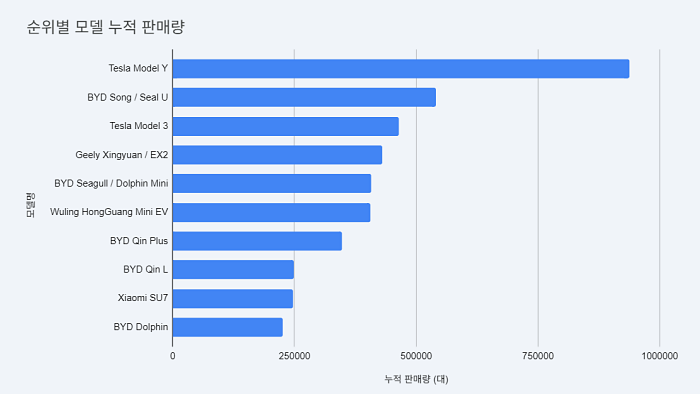
By individual model, the Tesla Model Y sold 937,558 units, maintaining an overwhelming presence as 1 in 20 EVs globally. China’s BYD Song and Seal U EV sold 540,000 units, followed by the Tesla Model 3, which sold more than 460,000 units to stay near the top. Rapid gains by emerging models such as the Geely Xingyuan (EX2) and Xiaomi SU7 also stood out.
The picture changed in combined brand results. BYD delivered about 2.25 million battery EVs in 2025, overtaking Tesla, which remained at about 1.63 million, to become the world’s largest EV maker. A 150 percent jump in overseas exports from a year earlier was decisive. Tesla, by contrast, recorded a decline for a second straight year as sales of its key models slowed.
China sold 12.32 million units from January to November, accounting for about 64 percent of the global market, and small EVs such as the Wuling Hongguang Mini EV and Geely Panda Mini led a practicality-focused consumer trend. Hyundai Motor Group sold about 570,000 units to keep its No. 8 global ranking.
 Hyunwoo Choo
cookinpapa@d-today.co.kr
Hyunwoo Choo
cookinpapa@d-today.co.kr