
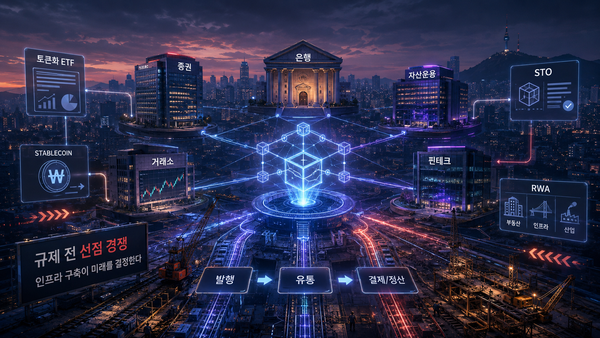
As debate continues in South Korea over institutionalising digital asset rules, the financial sector is speeding up efforts to secure related infrastructure. Banks, securities firms and asset managers are expanding points of contact beyond investment and cooperation with digital asset exchanges to global blockchain foundations, real-world asset (RWA) companies and token securities (STO) platform firms.
According to the industry on June 28, South Korean financial firms and fintech companies have since the start of this month been moving one after another to sign business agreements and make equity investments to build digital asset infrastructure.
Toss Bank is pursuing cooperation with the Solana Foundation on blockchain-based next-generation financial infrastructure. Mirae Asset Global Investments signed a business agreement with Ondo Finance to build an exchange-traded fund (ETF) tokenisation ecosystem. KB Securities has begun cooperation with the Canton Foundation and Wavebridge to build distributed-ledger-based digital asset infrastructure.
Korea Investment & Securities strengthened partnerships with Coinone, OKX and Com2uS Holdings to build a digital finance ecosystem. Earlier, Korea Investment & Securities and OKX Ventures each secured about 20 percent of Coinone, setting up a structure under which they jointly become the third-largest shareholders. Com2uS Holdings also remains a major shareholder of Coinone, continuing a cooperation framework in blockchain technology and the content ecosystem.
In the asset management industry, tokenisation has emerged as a key word. Mirae Asset Global Investments, through cooperation with Ondo Finance, is pursuing ETF tokenisation, on-chain asset management infrastructure and development of digital investment products for global investors.
It is also reviewing plans to expand the scope of tokenised assets from U.S.-listed ETFs to Canada, Europe, Australia, Japan and Hong Kong, and later to other asset classes including commodities.
In the securities industry, competition continues to secure token securities and distributed-ledger infrastructure. KB Securities is reviewing a plan to use the Canton Network to apply distributed-ledger-based infrastructure to domestic capital market transactions.
Its plan is to broaden the scope of cooperation in the mid to long term to include introducing distributed-ledger-based financial products domestically and building overseas distribution infrastructure.
DB Financial Investment signed a strategic business agreement with Nasdaq-listed K Wave Media (KWM) to build a token securities platform, Gaon (GAON), based on intellectual property (IP) for K-content.
Gaon is a Solana blockchain-based platform being 추진 by KWM. KWM will oversee planning, development and operations, while DB Financial Investment will advise on investor participation structures for domestic and foreign investors and the design of investment structures aligned with the Capital Markets Act.
Banks and the payments industry are focusing on remittances, settlement and payment infrastructure. Cooperation between Toss Bank and the Solana Foundation is an example of an internet-only bank verifying the feasibility of applying blockchain network-based financial infrastructure.
If legislation on stablecoins is put into full swing, the range of uses could expand to overseas remittances, payments, digital assets and tokenised assets.
In global markets, stablecoins and RWAs have already become major digital finance infrastructure. According to the industry, stablecoin issuance stands at $296.8 billion and RWA issuance is about $32.2 billion. Stablecoins are growing mainly around USDT and USDC, while RWAs are growing mainly around U.S. Treasury securities.
The financial sector's moves are closer to laying groundwork to secure market leadership after institutionalisation than to launching products for customers immediately. That is because many tasks remain unresolved, including the Digital Asset Basic Act, stablecoin rules, token securities issuance and distribution systems, and reviews of major shareholders' qualifications for exchanges.
As institutionalisation is delayed, the influence of overseas infrastructure companies is growing. On global exchanges, products that track domestic indices and South Korean stocks are already traded, but domestic institutions and exchanges find it difficult to handle related businesses directly due to insufficient systems.
This is why there are claims that even if global demand for South Korean products increases, the benefits could be concentrated in overseas exchanges and infrastructure companies.
A financial investment industry official said the competitive landscape in the digital asset market is shifting from exchange-centred competition to ecosystem competition involving financial groups, asset managers, payment firms and global infrastructure companies. After institutionalisation, the official said, competitiveness is expected to be determined by how much issuance, distribution, custody, payment and management infrastructure firms have secured, rather than simple support for trading.
 Sangyeob Oh
yub@d-today.co.kr
Sangyeob Oh
yub@d-today.co.kr