
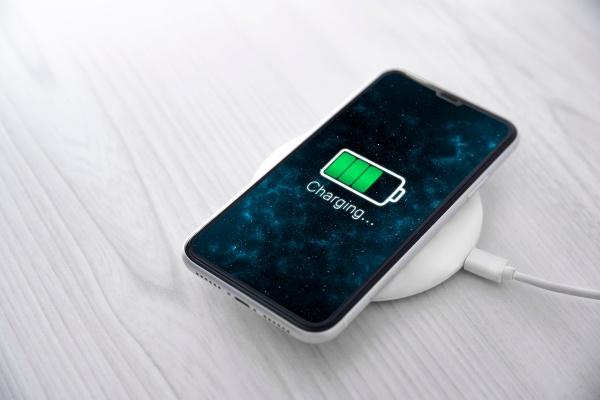
[DigitalToday reporter Jinju Hong] Wireless smartphone charging is found to consume up to 40% more power than wired charging. While it is more convenient, greater heat and energy loss could be unfavorable for battery life and the environment, an analysis shows.
According to IT outlet Engadget on June 24 (local time), charging a smartphone from 0% to 100% requires about 15Wh with wired charging, while wireless charging consumes about 21Wh, using up to about 40% more electricity.
The gap stems from structural characteristics of wireless charging. Wireless charging transfers power using electromagnetic induction. Unlike wired charging, in which a charger connects directly to a smartphone, energy is transmitted across an air gap, generating heat and causing power loss.
Engadget explained that power lost as heat during wireless charging can amount to about 20 to 30% of the total. It added that an additional roughly 5 to 10% power loss occurs when a charger converts household alternating current to direct current.
Actual test results were similar. The outlet cited a 2020 study and introduced findings that wireless charging can use up to 40% more power than wired charging. A 2024 test by repair specialist iFixit showed Apple MagSafe power consumption was about 36% higher than wired charging. It also found that if the phone and charging pad are not precisely aligned, charging efficiency can fall to about half.
Heat can affect battery life beyond a simple drop in efficiency. A charging pad heating up is itself a signal of wasted energy, and higher temperatures can accelerate deterioration of lithium-ion batteries.
Most smartphones have a protection function that automatically slows charging when battery temperature reaches about 45 degrees to prevent overheating. Experts advised using charging pads in well-ventilated places and avoiding charging under pillows or blankets.
As wireless charging becomes more widespread, an increase in overall power consumption is also a concern. Using wired charging for a smartphone over a year requires about 5.5kWh of electricity, but wireless charging rises to about 7.6kWh. A UK mobile consumer survey by the Wireless Power Consortium (WPC) and Deloitte found 30 to 66% of smartphone users use wireless charging pads or related accessories. The calculation shows that even if only 30% of the world’s roughly 7.6 billion smartphones use wireless charging, an additional about 4,830GWh of power could be consumed annually.
Safety also varies widely by product. In particular, low-cost unbranded chargers may lack temperature detection or foreign object detection (FOD) functions. If metal objects such as coins or keys are caught between a smartphone and charger, the risk of overheating can increase. Some high-output wireless chargers have also raised the possibility of affecting medical devices such as pacemakers by generating strong magnetic fields.
Environmental burden is also cited as a weakness of wireless charging. It consumes more power, and charging pads themselves remain as electronic waste. It is also pointed out that repeated charging at high temperatures over long periods can speed battery performance degradation, potentially bringing forward the time when a smartphone is replaced.
Wireless charging technology is also advancing. Newer standards such as MagSafe and Qi2 improve charging efficiency by increasing coil alignment accuracy. Even so, experts commonly view that unlike wired charging, which delivers power directly, wireless charging that uses magnetic fields structurally cannot avoid energy loss beyond a certain level.
In the end, the analysis says wireless charging has the advantage of convenience, but it is desirable to use it while also considering power efficiency, heat, safety and environmental impact.
 Jinju Hong
hongjj@d-today.co.kr
Jinju Hong
hongjj@d-today.co.kr